
🌵 Euphorbia ammak
Plant ID
GD-EUP-003-0001
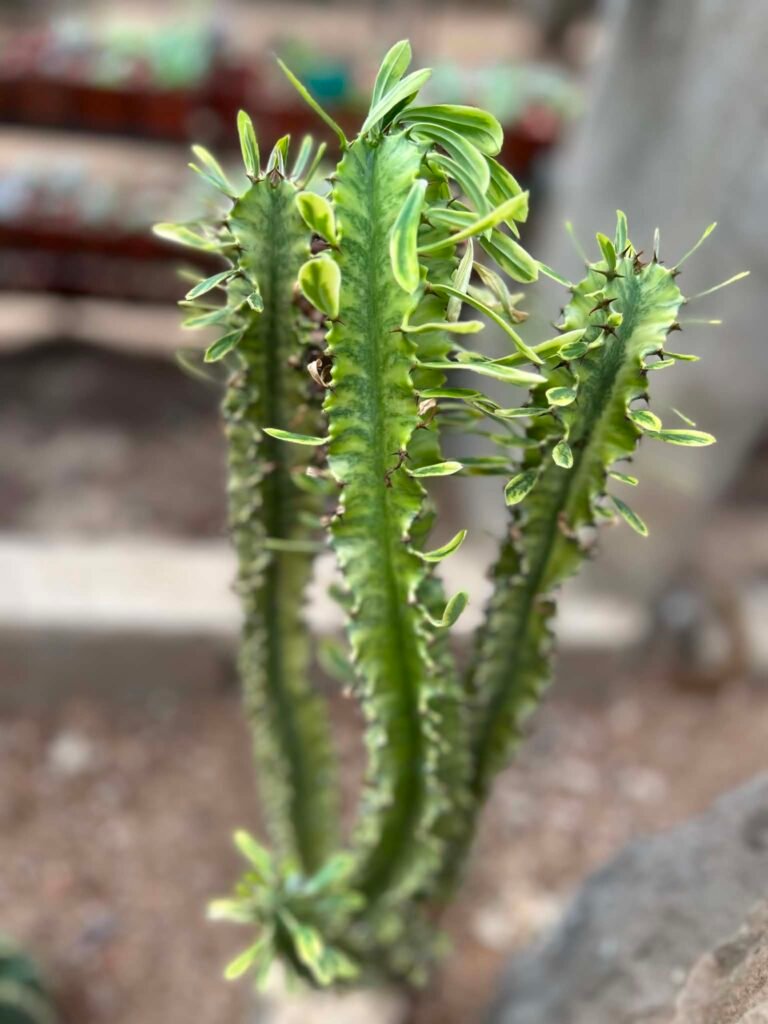
Photography: Green Desert Botanical Library
Basic Information
Scientific Name: Euphorbia ammak Schweinf.
Common Names:
- Ammak Spurge
- Saudi Candelabra Spurge
- Arabian Candelabra Euphorbia
Family: Euphorbiaceae
Genus: Euphorbia
Plant Type: Succulent tree
Origin: Saudi Arabia and western Yemen
Plant Overview
Euphorbia ammak is a magnificent tree-like succulent admired for its towering candelabra-shaped form and striking blue-green stems. Native to the rocky mountains of the Arabian Peninsula, it is among the tallest succulent Euphorbia species, capable of developing into an impressive landscape specimen. Its massive ribbed stems, paired spines, and architectural branching make it a dramatic focal point in xeriscapes, botanical gardens, and succulent collections.
Although often mistaken for a cactus, Euphorbia ammak belongs to the spurge family (Euphorbiaceae) and produces the characteristic white milky latex common to the genus.
Botanical Description
Growth Habit
An upright, tree-forming succulent with a strong central trunk that branches into a candelabra-like crown as it matures.
Mature Size
- Height: 5–10 meters (occasionally taller in habitat)
- Spread: 2–5 meters
Container-grown plants remain considerably smaller.
Stem
- Thick blue-green to gray-green stems
- Usually 4–6 winged ribs
- Broad, flat margins with undulating edges
- Covered with a waxy coating that reduces water loss
Spines
- Short paired brown to gray spines
- Located along the rib margins
- Usually 5–12 mm long
Leaves
Small, oval leaves emerge briefly on new growth during the growing season before naturally falling off.
Flowers
Produces tiny yellow-green cyathia near the stem tips, generally during warm growing periods.
Fruits
Small three-lobed capsules containing tiny seeds.
Native Habitat
Euphorbia ammak grows naturally on rocky mountain slopes and arid valleys of:
- Saudi Arabia
- Western Yemen
It thrives in:
- Full sun
- Rocky limestone soils
- Excellent drainage
- Hot, dry climates
- Seasonal rainfall
Growing Conditions
Light
- Full sun
- Very bright light indoors
- Gradual acclimation prevents sunburn after relocation
Watering
Water deeply only when the soil has completely dried.
General guideline:
- More frequent during active growth
- Minimal watering during cool seasons
Overwatering is the greatest cause of failure.
Soil
Requires an extremely fast-draining mineral-based soil mix containing materials such as:
- Pumice
- Lava rock
- Coarse sand
- Crushed granite
- Small amount of organic matter
Temperature
Ideal:
- 20–35°C
Protect from temperatures below 10°C.
Not frost tolerant.
Humidity
Prefers dry air and excellent air circulation.
Propagation
Propagation methods include:
- Stem cuttings
- Seeds (less common)
Allow cut surfaces to dry and callus completely before planting.
Because of its irritating latex, protective gloves should always be worn.
Growth Rate
Moderate to fast under warm conditions with abundant sunlight.
Toxicity
⚠ Caution
Like nearly all Euphorbia species, Euphorbia ammak contains white milky latex that can:
- Irritate skin
- Cause painful eye injuries
- Be toxic if ingested
Always wear gloves and avoid contact with eyes and mouth.
Keep away from children and pets.
Interesting Facts
- One of the largest succulent Euphorbia species.
- Native only to the Arabian Peninsula.
- Frequently mistaken for a giant cactus despite being unrelated.
- Its blue-green stems become more vibrant under bright sunlight.
- The waxy stem coating helps conserve moisture during prolonged drought.
- Often used as a dramatic specimen in desert landscaping.
Landscape and Collection Value
Ideal for:
- Desert gardens
- Xeriscapes
- Large succulent collections
- Botanical gardens
- Architectural landscape design
Its towering candelabra silhouette creates a dramatic visual centerpiece.
Conservation Status
Although locally common in parts of its native range, habitat disturbance and land development may affect some natural populations. Cultivated specimens help reduce pressure on wild plants.
Life’s Whisper
“Stand tall with quiet strength. Like Euphorbia ammak, true resilience is not measured by comfort, but by the courage to flourish where few others can.”
Green Desert Botanical Library Notes
Euphorbia ammak is one of the signature architectural succulents suitable for larger landscapes and spacious collections. Its commanding presence, drought tolerance, and sculptural beauty make it one of the finest representatives of the succulent spurges.
Navigation
🏠 Home: Botanical Library – Euphorbia Collection
➡ Next Plant: Euphorbia obesa
References
For the complete list of botanical references, scientific literature, and online resources used in preparing the Green Desert Botanical Library, please visit the References page available from the Main Menu.