
Plant ID
GD-CAC-002-0028
Identification Status: Provisional identification based on the submitted photograph.
Common Name(s)
Wessner’s Rebutia
Wessner’s Crown Cactus
Pink Rebutia
Clustered Rebutia
Accepted Botanical Placement: Rebutia minuscula var. wessneriana
The plant is also widely encountered in horticultural literature under the older name Rebutia wessneriana. Kew currently treats that name as a synonym of Rebutia minuscula var. wessneriana.
Plant Photograph
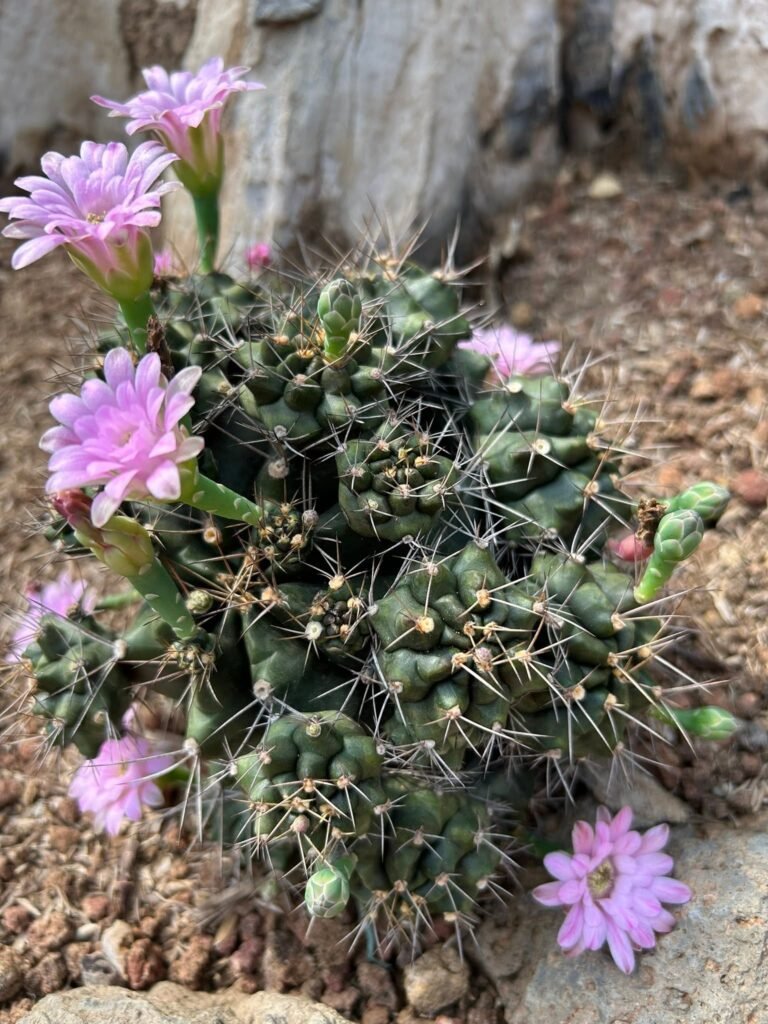
Photograph: Green Desert Botanical Library specimen photograph.
Picture Description
The photograph shows a vigorous, densely clustering cactus composed of numerous small, dark-green globular heads. The stems are strongly tuberculate, with the tubercles arranged in a spiral pattern.
Each areole produces a conspicuous group of slender, pale to whitish spines. Some spines are noticeably longer and extend outward from the body, creating an open, delicate spiny covering rather than a dense woolly coat.
Several beautiful pink to lilac-pink flowers are open simultaneously. The flowers arise laterally from the stems on elongated floral tubes, a characteristic feature of Rebutia. Numerous unopened buds can also be seen developing among the stems.
The combination of the compact clustering habit, tuberculate stems, long whitish spines, and lateral pink flowers makes this specimen particularly attractive.
Plant Description
Rebutia minuscula var. wessneriana is a small, clustering cactus belonging to the family Cactaceae. It produces numerous globular to depressed-globular stems that branch from the base and eventually form attractive low mounds.
The stems are green and divided into small tubercles that are arranged in spiral patterns. Areoles are positioned on the tubercles and carry numerous slender spines.
One of its most striking characteristics is its flowering display. Flowers emerge from the sides and lower portions of the stems rather than exclusively from the central growing point. They may be pink, violet-pink, reddish, or related shades.
Kew currently accepts Rebutia minuscula as a species and recognizes var. wessneriana as an accepted infraspecific taxon native to northwestern Argentina.
Basic Information
Scientific Name: Rebutia minuscula var. wessneriana (Bewer.) Eb.Scholz
Kingdom: Plantae
Phylum: Streptophyta
Class: Equisetopsida
Order: Caryophyllales
Family: Cactaceae
Genus: Rebutia
Species: Rebutia minuscula
Variety: wessneriana
Plant Type: Cactus / succulent
Growth Form: Globular, clustering cactus
Spines: Numerous, slender, whitish to pale
Native Country: Argentina
Native Range: Jujuy, northwestern Argentina
Natural Biome: Subtropical dryland environments
Kew lists Rebutia minuscula var. wessneriana as an accepted variety and gives its native range as Jujuy in northwestern Argentina.
Plant Overview
This small cactus is an excellent example of how a plant can transform a modest body into a spectacular floral display.
Individual heads remain relatively small, but the plant readily produces offsets from the base. Over time, these offsets form a dense colony or mound.
The body itself is interesting because the ribs are not sharply defined. Instead, they are expressed as rows of small tubercles arranged in spirals. Long, delicate spines emerge from the areoles, while the flowers appear from the sides of older portions of the stems.
When several heads bloom at the same time, the plant can become almost completely surrounded by flowers.
Botanical Description
Growth Habit
A small, freely clustering cactus that branches from the base and gradually forms low, compact groups.
Individual stems are globular to depressed-globular and may become somewhat elongated with age or under cultivation.
Mature Size
Individual stems generally remain small, while an established plant can form a considerably wider cluster.
Plants cultivated under favorable conditions may eventually develop clumps approximately 10–15 cm wide, although size varies with age and growing conditions.
Stem
The stems are bright to dark green and generally depressed-globular.
The ribs are poorly defined and are expressed as numerous small tubercles arranged in spiral patterns. Published descriptions report tubercles approximately 2 mm in size.
Leaves
True leaves are absent.
The fleshy green stem performs photosynthesis and stores water, allowing the plant to tolerate periods of environmental dryness.
Spines
The areoles produce numerous slender, bristle-like spines.
In this variety, spines can be particularly long, whitish, and somewhat interlacing. Descriptions of the wessneriana form report more than 20 spines per areole, with some reaching approximately 25 mm in length.
The photograph shows this characteristic particularly well, with long pale spines extending outward from the dark-green tuberculate stems.
Roots
The plant has a fibrous root system adapted to absorbing moisture quickly from its well-drained growing environment.
Good drainage is essential because prolonged wetness around the roots can lead to rot.
Flowers
Flowers are produced laterally from the sides and lower portions of the stems.
They are funnel-shaped and relatively large compared with the small body of the cactus. Flower color can range from red and orange to violet-pink, with the photograph showing an attractive pale pink to lilac-pink form.
The floral tube is relatively long and narrow, extending outward from the stem before opening into the broad flower. Descriptions of the wessneriana group report flowers reaching several centimeters in length and diameter.
Fruits
After successful pollination, small globular fruits develop from the flowers.
The fruits may become violet, reddish-violet, or similar shades as they mature.
Seeds
The seeds are small and dark, with a glossy seed coat.
Seed propagation is an important method of producing new plants and maintaining genetic diversity.
Native Habitat
Geographic Distribution
The accepted variety Rebutia minuscula var. wessneriana is native to Jujuy, northwestern Argentina.
The broader species Rebutia minuscula occurs in northwestern Argentina.
Natural Ecosystem
The species and its related forms occur in mountainous and seasonally dry environments of northwestern Argentina.
Plants are adapted to rocky, well-drained habitats where rainfall may be seasonal and water does not remain around the roots for prolonged periods.
Climate
The natural environment combines strong sunlight with seasonal moisture and dry periods.
The plant’s small succulent stems and specialized root system allow it to take advantage of available moisture while surviving periods of drought.
Cultivation & Care
Light
Provide bright light with several hours of direct sunlight.
In very hot climates, some protection from the strongest afternoon sun may be beneficial, particularly when the plant has not been acclimatized.
Good light is important for maintaining compact growth and encouraging flowering.
Watering
Water thoroughly during active growth, then allow the growing medium to dry before watering again.
Reduce watering during cool or dormant periods.
Avoid keeping the root zone continuously moist.
Soil
Use a very well-draining cactus and succulent medium.
A mineral-rich mixture containing pumice, lava rock, coarse sand, perlite, and other porous materials is suitable.
The soil should remain loose and allow air to reach the roots.
Temperature
The plant prefers cool-to-warm growing conditions with good air circulation.
Although it can tolerate some cooler temperatures when completely dry, protection from prolonged cold combined with moisture is recommended.
Fertilization
Apply a diluted cactus and succulent fertilizer during active growth.
A fertilizer with moderate nitrogen and adequate phosphorus and potassium can support healthy growth and flowering.
Avoid excessive feeding, which can produce soft, elongated growth.
Drainage
Excellent drainage is essential.
Use a container with adequate drainage holes and never allow water to accumulate around the roots.
Propagation
Rebutia minuscula var. wessneriana can be propagated by seed and offsets.
Seed Propagation
- Use fresh, viable seeds.
- Sow them on a clean, porous cactus propagation medium.
- Keep the medium lightly moist during germination.
- Provide warmth and bright filtered light.
- Maintain good ventilation.
- Avoid prolonged saturation.
- Gradually reduce moisture as seedlings become established.
- Transplant young plants carefully when they are sufficiently developed.
Offset Propagation
The plant naturally produces offsets from the base.
Offsets can be carefully separated when sufficiently developed and allowed to callus before being planted in a dry, well-draining medium.
Interesting Facts
- The plant can form dense clusters from numerous basal offsets.
- Its small body can produce flowers that are remarkably large in comparison with the individual stem.
- Flowers arise laterally from the stem, rather than only from the apex.
- The tubercles are arranged in attractive spiral patterns.
- Some descriptions report more than 20 long spines per areole, giving the plant a delicate but impressive spiny appearance.
- Flower color can vary considerably within the Rebutia minuscula complex.
- Several names historically used for this plant are now treated as synonyms or forms within Rebutia minuscula. Kew currently recognizes Rebutia minuscula var. wessneriana.
- The flowers may appear in large numbers, creating a spectacular flowering mound.
- Its small size makes it especially attractive for cactus collections and specimen displays.
Life’s Whisper
🌸 “Sometimes the smallest beginnings create the greatest display.”
Life’s whisper:
Never underestimate the beauty that can grow from small beginnings.
Navigation
⬅ Previous Genus: Astrophytum
🏠 Home: Botanical Library – Rebutia Collection
➡ Next Genus: [Next Genus]
References
For the complete list of botanical references, scientific literature, and online resources used in preparing the Green Desert Botanical Library, please visit the References page available from the Main Menu.
🌵 Green Desert Botanical Library
Where Every Plant Has a Story to Tell.
Discover the Story. Grow the Wonder.