
Plant ID
GD-CAC-008-0034
Common Name(s)
Golden Ball Cactus
Lemon Ball Cactus
Yellow Tower Cactus
Plant Photograph
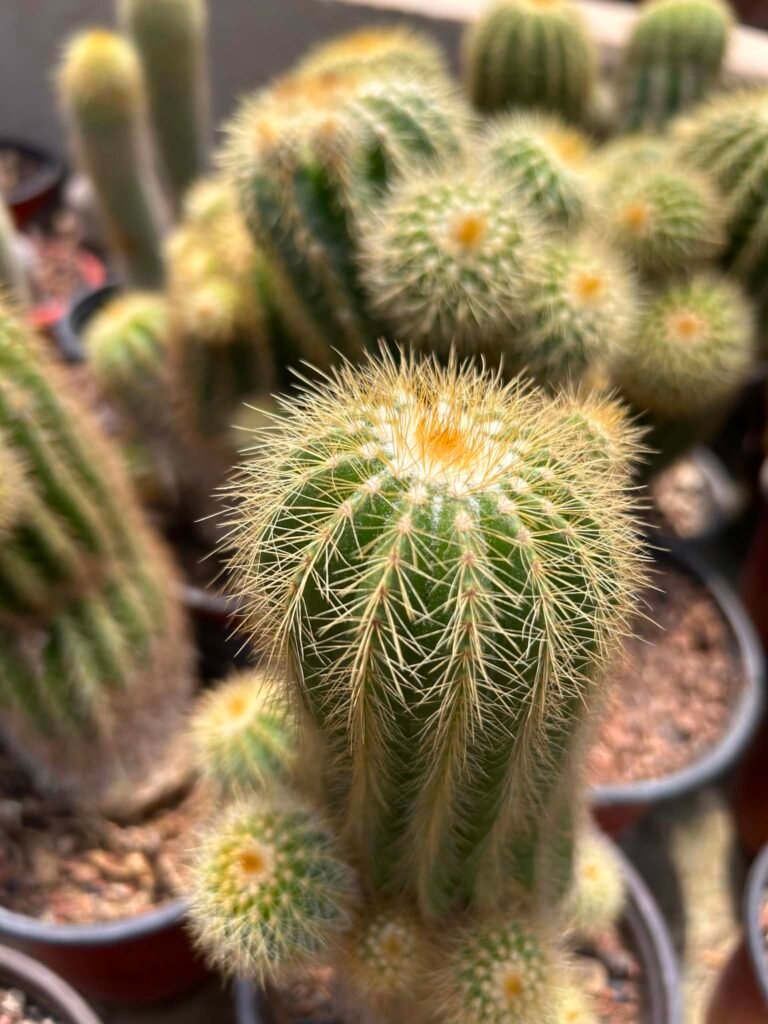
Photograph: Green Desert Botanical Library specimen photograph.
Picture Description
The photograph shows a strongly clustering Parodia lenninghausii with upright, cylindrical green stems densely covered by extremely fine, golden-yellow, hair-like spines.
The central stem displays a particularly dense crown of golden spines, while numerous offsets develop around the base, creating a multi-stemmed cluster.
Plant Description
Parodia lenninghausii is a striking South American cactus recognized for its cylindrical stems and exceptionally dense covering of fine golden spines. Young plants are more rounded, becoming increasingly cylindrical with age. Mature plants may produce numerous basal offsets and form impressive clusters.
The species is particularly valued in cultivation for its soft-looking golden spination, which gives mature specimens a distinctive yellow-golden appearance.
Basic Information
Scientific Name: Parodia lenninghausii (F.Haage) F.H.Brandt ex Eggli & Hofacker
Kingdom: Plantae
Phylum: Streptophyta
Class: Equisetopsida
Order: Caryophyllales
Family: Cactaceae
Genus: Parodia
Species: Parodia lenninghausii
Plant Type: Cactus / succulent
Growth Form: Globular when young; cylindrical and clustering with age
Stem Color: Green
Ribs: Numerous, narrow and low
Spines: Fine, hair-like, pale yellow to deep golden-yellow or brown
Flowers: Lemon-yellow
Native Range: Rio Grande do Sul, Brazil
Kew currently accepts Parodia lenninghausii as the species name. Several historically used names, including Notocactus lenninghausii and Eriocactus lenninghausii, are treated as synonyms.
Plant Overview
Parodia lenninghausii is one of the most recognizable golden-spined cacti in cultivation.
Young plants begin as rounded bodies, but with maturity the stems become short-columnar to cylindrical. Older plants may produce offsets from the base, eventually forming substantial clusters.
The dense golden spines are its defining ornamental feature. When illuminated from behind, the fine spines can give the entire plant a glowing golden appearance.
Botanical Description
Growth Habit
The plant may begin as a solitary globular cactus and gradually develop a cylindrical form.
Mature specimens commonly produce basal offsets and may form dense clusters.
Mature Size
Individual stems may reach approximately 60 cm or more in height and 7–10 cm in diameter under suitable conditions.
Stem
The stem is green, cylindrical and usually upright, sometimes becoming slightly slanted toward the apex.
The mature stem has approximately 30–35 low, straight ribs with closely spaced areoles.
Leaves
True leaves are absent.
The green stem performs photosynthesis and stores water.
Spines
The spines are exceptionally fine and hair-like.
They range from pale yellow through deep yellow to brown. Each areole may bear numerous radial spines together with several longer central spines.
The golden coloration is particularly prominent toward the newer growth and apex, as seen in the Green Desert specimen.
Roots
The plant develops a cactus root system adapted to absorbing moisture efficiently from well-drained soil.
Flowers
The flowers are lemon-yellow, appearing near the upper portion of mature stems.
They are approximately 5–6 cm across, with flower areoles bearing dense brown wool and bristles.
Fruits
The fruit is approximately globose and around 2 cm in height.
Seeds
The seeds are described as bell-shaped and brownish-red.
Native Habitat
Geographic Distribution
Parodia lenninghausii is native to Rio Grande do Sul, southern Brazil.
Natural Ecosystem
The species grows on basaltic rocky walls and rock outcrops associated with the river basins of the Serra Geral formation.
Climate
Its natural environment is seasonally influenced, with moisture available throughout parts of the year but with excellent drainage provided by the rocky habitat.
Cultivation & Care
Light
Provide bright light to full sun.
In very hot climates, gradual acclimatization and some protection from intense afternoon heat may be beneficial.
Watering
Water thoroughly during active growth, allowing the growing medium to dry before watering again.
Reduce watering during cooler or dormant periods.
Soil
Use a very well-draining cactus and succulent medium containing mineral components such as pumice, lava rock, coarse sand, or perlite.
Temperature
Provide warm growing conditions with good air circulation.
The species can tolerate relatively cool conditions when kept dry, but prolonged freezing should be avoided.
Fertilization
Apply a diluted cactus fertilizer during active growth.
Avoid excessive nitrogen.
Drainage
Excellent drainage is essential.
Never allow the roots to remain in stagnant water.
Propagation
Parodia lenninghausii can be propagated by seeds and offsets.
Seed Propagation
- Sow seeds in a clean, porous cactus medium.
- Keep the medium lightly moist during germination.
- Provide warmth and bright filtered light.
- Maintain good ventilation.
- Avoid prolonged saturation.
- Gradually reduce moisture as seedlings become established.
Offset Propagation
Mature plants may produce basal offsets.
Well-developed offsets can be carefully separated and allowed to callus before planting in a well-draining cactus medium.
Interesting Facts
- Parodia lenninghausii is currently an accepted species according to Kew.
- It is native to Rio Grande do Sul, Brazil.
- Young plants are generally more globular, while mature plants become cylindrical.
- Mature plants may form large clusters through basal offsets.
- The plant is covered by numerous extremely fine golden-yellow bristles.
- Its flowers are lemon-yellow and can reach approximately 5–6 cm across.
- Notocactus lenninghausii and Eriocactus lenninghausii are among its historical names.
- The species was named in honor of Guillermo Lenninghaus, a cactus collector associated with Rio Grande do Sul.
- Its fine golden spines can create a striking glowing effect when viewed in backlight.
Life’s Whisper
“Sometimes, the brightest beauty is found in the smallest threads of gold.”
Navigation
⬅ Previous Plant: Parodia magnifica
🏠 Home: Botanical Library – Parodia Collection
➡ Next Plant: [Next Plant]
References
For the complete list of botanical references, scientific literature, and online resources used in preparing the Green Desert Botanical Library, please visit the References page available from the Main Menu.
🌵 GREEN DESERT BOTANICAL LIBRARY
WHERE EVERY PLANT HAS A STORY
DISCOVER THE STORY • GROW THE WONDER