
Green Desert Botanical Library
Plant Page
Home → Botanical Library → Mammillaria → Mammillaria vetula
Plant ID
GD-CAC-014-0056
Scientific Name: Mammillaria vetula Mart.
Family: Cactaceae
Genus: Mammillaria
Species: Mammillaria vetula
Specimen: A
Library Record Name: Mammillaria vetula — Specimen A
Common Name(s)
Thimble Cactus
Thimble Pincushion Cactus
Formerly / Commonly Recorded As: Mammillaria gracilis
Taxonomic Synonym: Mammillaria vetula subsp. gracilis
Kew currently accepts Mammillaria vetula as the species name and treats Mammillaria gracilis and Mammillaria vetula subsp. gracilis as synonyms. Plants of the World Online
Plant Photograph
Figure 1. Mammillaria vetula — Specimen A
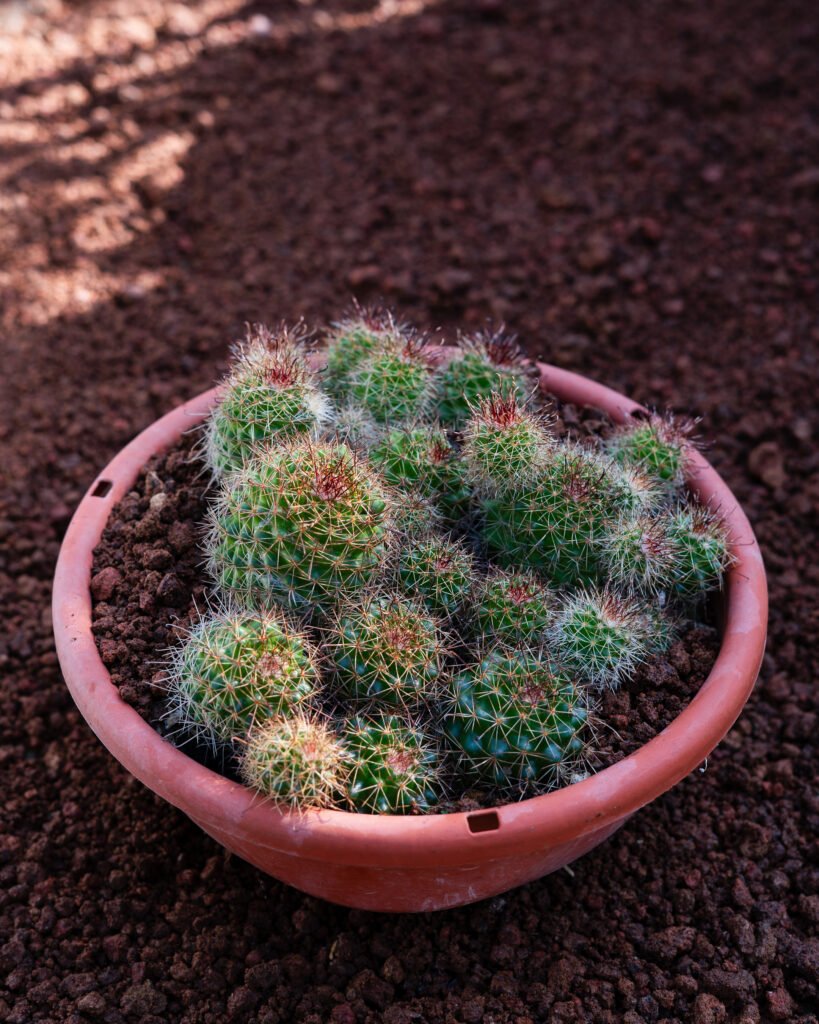
Identification: Mammillaria vetula Mart.
Photo Caption:
A densely clustered Mammillaria vetula displaying numerous small cylindrical heads covered with fine pale radial spines and reddish central spines. The specimen is notable for its abundant offsets, which characteristically separate readily from the parent plant.
Photography: John Niño G. Ewa (@_____.5am)
Basic Information
| Character | Information |
|---|---|
| Growth Form | Highly clustering, forming numerous small cylindrical offsets |
| Stem | Small, cylindrical to short-cylindrical, green |
| Tubercles | Conical to cylindrical, arranged in compact spirals |
| Areoles | Small, with wool and spines |
| Radial Spines | Numerous, fine and whitish |
| Central Spines | Present in the photographed gracilis-type specimen; some reddish and hook-like |
| Offsets | Numerous and exceptionally easy to detach |
| Flowers | Small, pale to yellowish-white, sometimes with pinkish tones |
| Natural Range | Mexico, from Guanajuato to Veracruz |
| Specimen Character | Dense clustering with readily detachable offsets |
Kew records the native range of Mammillaria vetula as Mexico from Guanajuato to Veracruz. Plants of the World Online
Plant Description
Specimen A is a densely clustered, gracilis-type Mammillaria composed of numerous compact cylindrical heads. The stems are green and heavily covered by fine pale spines, with occasional reddish, hook-like central spines visible among the areoles.
The most notable feature of this specimen is its prolific offsetting. The young heads are loosely connected to the parent plant and can separate with exceptionally little physical disturbance, producing the characteristic colony-forming appearance associated with the traditional Mammillaria gracilis name.
For this specimen, the readily detachable offsets are considered an important collection-level identification observation.
Life’s Whispers
“Even the smallest beginnings can become a multitude.
Grow freely, hold gently, and never fear beginning again.
Sometimes separation is not an ending,
but the beginning of another life.”
Navigation
← Previous Plant | Mammillaria Genus Page | Next Plant → | Main Menu
References
For the complete botanical references supporting this Plant Page, please see:
🌵 GREEN DESERT BOTANICAL LIBRARY
WHERE EVERY PLANT HAS A STORY
DISCOVER THE STORY • GROW THE WONDER