
Plant ID
GD-CAC-001-0024
Common Name(s)
- Golden Barrel Cactus
- Golden Barrel
- Short-Spined Golden Barrel
- Short-Spined Golden Barrel Cactus
- Golden Ball Cactus
- Mother-in-Law’s Seat
Plant Photograph
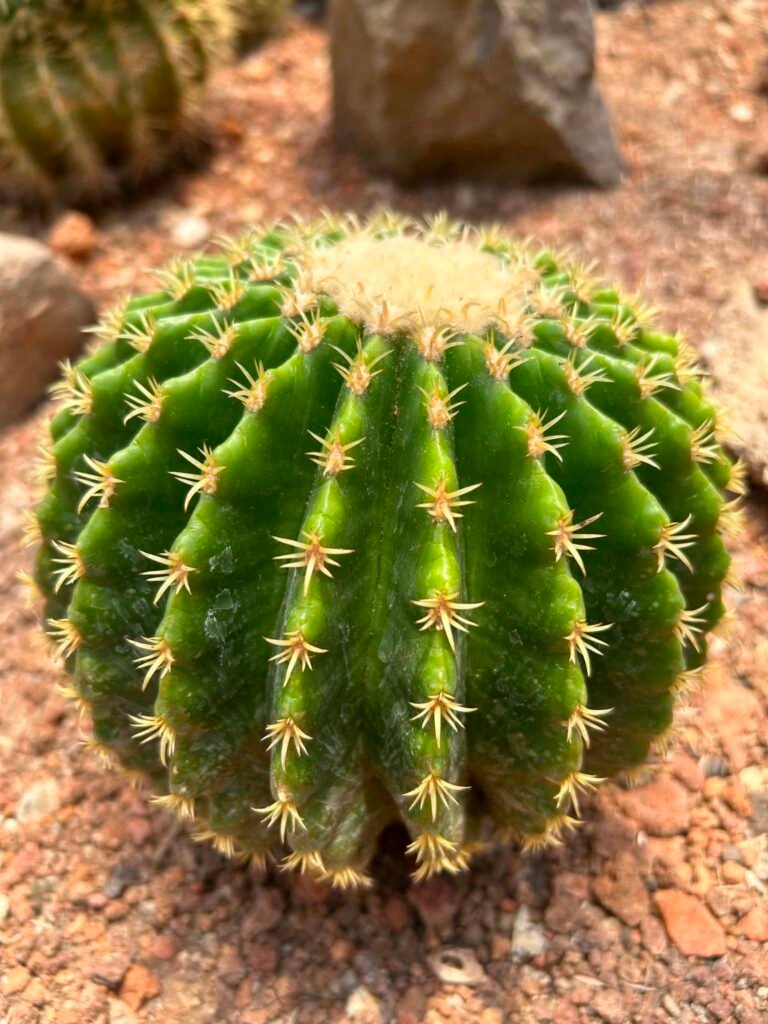
📷 Figure 1. Echinocactus grusonii Hildm. — Short-Spined Form
Picture Description
Photography: Green Desert Botanical Library Collection
A close-up view of a short-spined Golden Barrel Cactus, showing its rounded green body with numerous strongly defined ribs and regularly arranged areoles. Unlike the typical Golden Barrel, this specimen produces noticeably shorter golden-yellow spines, allowing more of the bright green body to remain visible. The growing crown is covered with dense golden wool. Photographed at Green Desert Agritourism Park, this specimen demonstrates the distinctive short-spined form of one of the world’s most recognizable barrel cacti.
Plant Description
Echinocactus grusonii Hildm. is the well-known Golden Barrel Cactus, a highly symmetrical barrel-shaped cactus native to Mexico. This specimen represents a short-spined horticultural form, distinguished from the typical plant by its noticeably reduced spine length.
The short-spined character has historically been associated with names such as Echinocactus grusonii var. subinermis and Echinocactus grusonii fa. brevispinus. The Huntington Botanical Gardens documented Echinocactus grusonii fa. brevispinus as a form with shorter-than-normal spines, while specialist cactus references associate subinermis with the very short-spined type.
The reduced spines reveal more of the plant’s vivid green epidermis and give this specimen a distinctly different appearance from the heavily golden-spined standard form.
Basic Information
Scientific Name: Echinocactus grusonii Hildm.
Current Taxonomic Placement: Kroenleinia grusonii (Hildm.) Lodé
Family: Cactaceae
Genus: Echinocactus
Current Genus Placement: Kroenleinia
Plant Type: Solitary barrel-shaped cactus
Form: Short-Spined Form
Historical/Horticultural Designations: Echinocactus grusonii var. subinermis; Echinocactus grusonii fa. brevispinus
Origin: Mexico
Kew currently treats Echinocactus grusonii as a synonym of Kroenleinia grusonii.
Plant Overview
The short-spined Golden Barrel retains the characteristic rounded to barrel-shaped body, deep ribs, regularly spaced areoles, and golden wool of the familiar Golden Barrel.
Its defining feature is its shorter spination.
In the typical Golden Barrel, the long golden spines can almost obscure the green body. In this specimen, the shorter spines leave much more of the green epidermis visible, creating a cleaner and more strongly ribbed appearance.
The short-spined form has been maintained in cultivation as a distinctive horticultural selection and is valued by collectors for its unusual appearance. The Huntington Botanical Gardens specifically described the brevispinus form as having shorter-than-normal spines that reveal the bright green epidermis.
Botanical Description
Growth Habit
A solitary, globose to barrel-shaped cactus with numerous prominent ribs.
The body becomes increasingly barrel-shaped as the plant matures.
Mature Size
- Generally similar in overall size and form to the typical Golden Barrel
- Individual specimens may eventually become large
- Mature cultivated plants can develop a substantial barrel-shaped body
The short-spined characteristic primarily affects spination, rather than fundamentally changing the overall growth form of the species.
Stem
- Bright green to dark green
- Globose when young
- Barrel-shaped with maturity
- Strongly ribbed
- Succulent and water-storing
- Highly symmetrical
Leaves
None.
As with other cacti, leaves have been evolutionarily modified into spines.
Ribs
- Numerous prominent vertical ribs
- Deeply defined
- Regularly arranged
- Clearly visible beneath the shorter spines
Spines
The principal distinguishing characteristic of this specimen.
- Shorter than those of the typical Golden Barrel
- Yellow to golden-yellow
- Produced in clusters from woolly areoles
- Strong but relatively compact
- Leave more of the green stem exposed
The brevispinus form is specifically characterized by shorter-than-normal spines.
Roots
A shallow, spreading cactus root system adapted to rapidly draining soils.
Flowers
- Yellow
- Funnel-shaped
- Produced around the crown of mature plants
- Appear during the warmer growing season
Fruits
Small fleshy fruits develop after successful pollination.
Seeds
Produces numerous small seeds enclosed within mature fruits.
Native Habitat
Geographic Distribution
Mexico.
The species is native to a restricted region of central Mexico.
Natural Ecosystem
Typical habitats include:
- Semi-arid landscapes
- Rocky terrain
- Dry shrubland
- Desert environments
Climate
Warm and seasonally dry conditions characterized by:
- Strong sunlight
- Seasonal rainfall
- Extended dry periods
- Well-drained soils
Soil Type
Mineral-rich, rocky and sharply draining soils.
Growing Conditions
Light
Thrives in bright light to full sun.
Gradually acclimatize plants to intense direct sunlight.
Watering
Water thoroughly during active growth and allow the growing medium to dry before watering again.
Reduce watering during cooler or dormant periods.
Avoid prolonged wet soil.
Soil
Use a porous, rapidly draining cactus mixture containing substantial mineral material.
Suitable components include:
- Pumice
- Lava rock
- Coarse sand
- Perlite
- Other porous mineral materials
Temperature
Ideal:
20–30°C during active growth
Protect from prolonged cold, particularly when the soil is wet.
Humidity
Prefers good ventilation and relatively dry conditions.
Excellent air circulation is especially important in humid tropical climates.
Fertilization
Feed lightly during active growth using a diluted cactus fertilizer.
Avoid excessive nitrogen.
Potting
Use a container with excellent drainage.
Choose a pot appropriate to the root system and avoid excessive soil volume that may remain wet.
Propagation
Usually propagated from seeds.
Seed propagation is particularly valuable because the short-spined characteristic may require selection among seedlings.
Growth Rate
Slow.
The plant requires many years to develop into a large mature specimen.
Dormancy
Growth slows during cooler or drier periods.
Maintain the plant relatively dry during periods of low growth.
Toxicity
⚠ Caution
The plant does not produce irritating milky latex like Euphorbia, but its spines can cause painful punctures.
Handle carefully when:
- Repotting
- Moving
- Cleaning
- Propagating
Pests and Diseases
Common problems include:
- Mealybugs
- Scale insects
- Spider mites
- Root rot
- Fungal diseases
- Stem rot caused by prolonged moisture
Good drainage and air circulation are essential.
Interesting Facts
- This is a short-spined form of the Golden Barrel Cactus.
- The normal species is famous for its numerous golden-yellow spines.
- The short-spined form exposes considerably more of the green epidermis.
- The short-spined character has historically been associated with subinermis and brevispinus.
- The horticultural name ‘Togenashi Kinshachi’ is associated with a very short-spined Golden Barrel.
- The plant retains the same strongly ribbed architectural form as the typical Golden Barrel.
- Mature plants can eventually produce yellow flowers around the crown.
- The species is one of the world’s best-known ornamental barrel cacti.
- The short-spined form is particularly attractive because its green body is much more visible.
Landscape and Collection Value
Ideal for:
- Cactus collections
- Botanical gardens
- Xeriscape gardens
- Rock gardens
- Container cultivation
- Greenhouse collections
- Specialty cactus displays
The short-spined form has particular value in a botanical collection because it provides an excellent visual comparison with the standard Golden Barrel.
At Green Desert Agritourism Park, it can be displayed alongside the ordinary long-spined form to demonstrate variation within a familiar cultivated cactus.
Conservation Status
The short-spined form is a cultivated horticultural selection of Echinocactus grusonii rather than a separately assessed wild species.
The species itself has a restricted natural distribution in Mexico and is considered threatened in its native habitat. The Golden Barrel has experienced significant habitat loss and illegal collection pressures.
Cultivated specimens therefore have value for ex-situ conservation, education, and public appreciation.
Life’s Whisper
“You do not have to carry the same defenses as everyone else. Like the Short-Spined Golden Barrel, your strength may be expressed quietly—revealing more of the beauty within.”
Green Desert Botanical Library Notes
This specimen forms part of the living collection of Green Desert Agritourism Park and is documented within the Echinocactus Plant Directory.
Its overall morphology clearly corresponds to the Golden Barrel Cactus, while the markedly shorter golden spines distinguish it from the typical long-spined form.
For the Green Desert Botanical Library, this specimen is therefore recorded as:
_Echinocactus grusonii Hildm. — Short-Spined Form
Historical horticultural names associated with this type include Echinocactus grusonii var. subinermis and Echinocactus grusonii fa. brevispinus. These names are retained as historical/horticultural references rather than presented as current accepted botanical varieties.
The current Kew placement of the species is Kroenleinia grusonii.
This specimen is especially valuable to the Green Desert collection because it demonstrates morphological variation within a familiar and iconic cactus.
Navigation
⬅ Previous Plant: Echinocactus — Previous Collection Specimen
🏠 Home: Botanical Library – Echinocactus Collection
➡ Next Plant: Echinocactus — Next Collection Specimen
References
For the complete list of botanical references, scientific literature, and online resources used in preparing the Green Desert Botanical Library, please visit the References page available from the Main Menu.