
Plant ID
GD-CAC-004-0022
Common Name(s)
- Goat’s Horn Cactus
- Goat Horn Cactus
- Horned Astrophytum
Plant Photograph
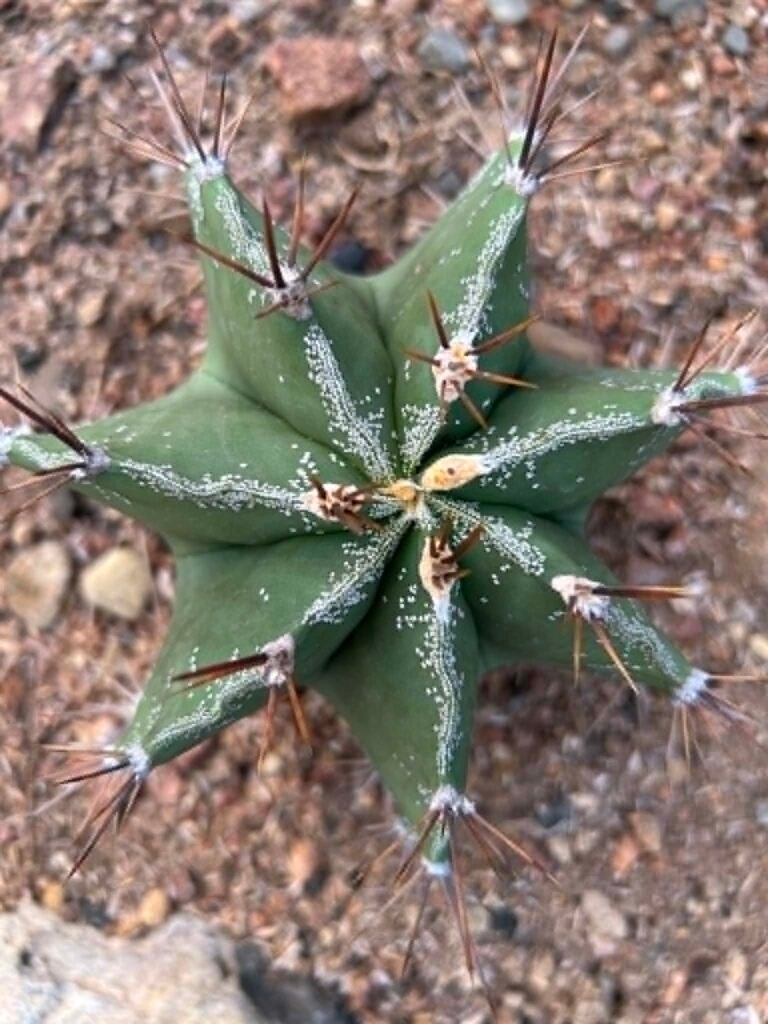
📷 Figure 1. Astrophytum capricorne (A.Dietr.) Britton & Rose
Picture Description
A close-up view of Astrophytum capricorne showing its distinctive green, ribbed body covered with irregular white flecking. The prominent ribs form a star-like pattern around the growing point, while long, slender brownish spines extend outward from the areoles and curve slightly, giving the plant its characteristic horn-like appearance. Photographed at Green Desert Agritourism Park, this specimen clearly illustrates the sculptural form and distinctive spination that make the Goat’s Horn Cactus a prized member of the Astrophytum collection.
Plant Description
Astrophytum capricorne is a distinctive solitary cactus recognized for its strongly ribbed green body, white flecking, and unusually long, twisted spines. The combination of the angular ribs and curved spines gives the plant a sculptural appearance resembling the horns of a goat, inspiring its common name.
The species belongs to the genus Astrophytum, a group of compact North American cacti known for their geometric forms, woolly areoles, and attractive flowers.
When mature, Astrophytum capricorne can develop a substantial spherical to ovoid body. During the flowering season, it produces large yellow flowers, adding another striking feature to an already highly ornamental cactus.
Basic Information
Scientific Name: Astrophytum capricorne (A.Dietr.) Britton & Rose
Author Citation: (A.Dietr.) Britton & Rose
Family: Cactaceae
Genus: Astrophytum
Plant Type: Solitary ribbed cactus
Origin: Northeastern Mexico
Plant Overview
Astrophytum capricorne is one of the most distinctive members of the Astrophytum genus.
Its green stem is divided into prominent ribs that give the plant a strongly geometric appearance. Small white flecks are scattered across the epidermis, creating a contrasting pattern against the green surface.
The most remarkable feature is its long, twisted spines. These may curve and spread outward from the areoles, producing the horn-like appearance that gives the species its common name.
Unlike many strongly clustering cactus species, Astrophytum capricorne generally develops as a solitary specimen, making a mature plant particularly striking as an individual display plant.
Botanical Description
Growth Habit
A generally solitary, globose to ovoid cactus with prominent ribs.
The plant gradually increases in size and may become somewhat elongated with age.
Mature Size
- Height: approximately 20–25 cm
- Diameter: approximately 10 cm
- Mature plants may become larger under favorable cultivation conditions
Stem
- Green to gray-green
- Spherical to ovoid
- Strongly ribbed
- Usually 7–9 prominent ribs
- Covered with scattered white flecks
- Succulent and water-storing
Leaves
None.
As with other cacti, the leaves have been evolutionarily modified into spines.
Spines
- Long and slender
- Yellowish-brown to brown
- Often twisted or curved
- Produced from woolly areoles
- May extend prominently away from the stem
The long twisted spines are one of the most distinctive characteristics of the species.
Roots
A succulent cactus root system adapted to dry, rapidly draining soils.
The roots are sensitive to prolonged waterlogging.
Flowers
- Large and funnel-shaped
- Yellow
- Produced near the growing point
- Generally appear during the warmer growing season
- May reach approximately 6–10 cm across
The flowers provide a striking contrast to the green, white-flecked and heavily spined body.
Fruits
Small fleshy fruits develop following successful pollination.
Seeds
Produces numerous small seeds within the mature fruits.
Native Habitat
Geographic Distribution
Northeastern Mexico
The species is native to northeastern Mexico.
Natural Ecosystem
Typical habitats include:
- Desert landscapes
- Dry shrubland
- Rocky areas
- Semi-arid regions
Climate
Warm and seasonally dry conditions characterized by:
- Strong sunlight
- High daytime temperatures
- Seasonal rainfall
- Extended dry periods
- Cooler nighttime temperatures
Soil Type
Naturally associated with poor, mineral-rich and sharply draining soils, often with sandy or rocky components.
Growing Conditions
Light
Thrives in bright light to full sun.
Strong light helps maintain the compact form and characteristic coloration of the plant.
Gradual acclimatization is recommended when moving a specimen into intense direct sunlight.
Watering
Water thoroughly during active growth and allow the soil to dry before watering again.
Keep the plant significantly drier during cooler or dormant periods.
Avoid prolonged moisture around the roots.
Soil
Use a sharply draining cactus and succulent mixture containing a high proportion of mineral material.
Suitable components include:
- Pumice
- Lava rock
- Coarse sand
- Perlite
- Other porous mineral materials
Temperature
Ideal:
20–30°C during active growth
The plant can tolerate relatively cool conditions when kept dry, but prolonged cold combined with wet soil should be avoided.
Humidity
Prefers good ventilation and relatively dry conditions.
In humid tropical environments, excellent air circulation and rapid drainage are especially important.
Fertilization
Feed lightly during active growth with a diluted cactus fertilizer.
Avoid excessive nitrogen because overly vigorous growth can weaken the compact natural form.
Potting
Use a container with excellent drainage.
A relatively deep pot may be useful because a healthy root system needs sufficient space while still requiring rapid drainage.
Avoid oversized containers that retain excessive moisture.
Propagation
Usually propagated from seeds.
Sow seeds in a clean, porous cactus-growing medium under suitable warm conditions.
Seed propagation is the preferred method for maintaining genetic diversity.
Growth Rate
Slow.
The species takes several years to develop into a mature specimen.
Dormancy
Growth slows during cool or dry periods.
A relatively dry resting period is beneficial and helps prevent root problems.
Toxicity
⚠ Generally considered non-toxic
Astrophytum capricorne does not produce the irritating milky latex characteristic of Euphorbia.
However, the long spines can cause:
- Skin punctures
- Minor wounds
- Irritation
Handle carefully when repotting or relocating the plant.
Pests and Diseases
Common problems include:
- Mealybugs
- Scale insects
- Spider mites
- Root rot caused by overwatering
- Fungal problems associated with prolonged moisture
- Stem rot in poorly ventilated conditions
Good drainage and appropriate watering are the most important preventive measures.
Interesting Facts
- The species is commonly known as the Goat’s Horn Cactus because of its long, curved spines.
- It is native to northeastern Mexico.
- The stem normally has 7–9 prominent ribs.
- White flecking creates an attractive contrast against the green epidermis.
- The long spines are yellowish-brown and often twisted.
- The species produces large yellow flowers.
- It generally grows as a solitary cactus rather than forming large clusters.
- It is one of the six species currently accepted in the genus Astrophytum by Kew.
- Several historical varieties and forms have been described, but many are now treated as synonyms of Astrophytum capricorne.
Landscape and Collection Value
Ideal for:
- Cactus collections
- Botanical gardens
- Rock gardens
- Xeriscape displays
- Container cultivation
- Greenhouses
- Specialty cactus collections
Its unusual rib structure, white flecking, and long twisted spines make it particularly valuable as a specimen cactus.
The sculptural appearance of the plant provides visual interest even when it is not flowering.
Conservation Status
Astrophytum capricorne is currently recognized as an accepted species.
The IUCN assessment cited by Kew lists the species as Least Concern (LC).
Cultivated specimens contribute to ex-situ conservation by maintaining living representatives of Mexico’s distinctive desert cactus flora.
Life’s Whisper
“Strength can take many forms. Like the Goat’s Horn Cactus, we can remain firmly rooted while turning even the challenges around us into something beautiful.”
Green Desert Botanical Library Notes
This specimen forms part of the living collection of Green Desert Agritourism Park.
Its prominent ribs, white flecking, and long brownish twisted spines strongly support its identification as Astrophytum capricorne (A.Dietr.) Britton & Rose.
The specimen is therefore placed within the Astrophytum Collection of the Green Desert Botanical Library rather than the Rebutia Collection.
This plant represents an excellent example of the architectural diversity found among small desert cacti. Its geometric body and distinctive horn-like spination make it particularly valuable as an educational and display specimen.
Navigation
⬅ Previous Plant: Astrophytum — Previous Collection Specimen
🏠 Home: Botanical Library – Astrophytum Collection
➡ Next Plant: Astrophytum — Next Collection Specimen
References
For the complete list of botanical references, scientific literature, and online resources used in preparing the Green Desert Botanical Library, please visit the References page available from the Main Menu.