
Home → Botanical Library → Alluaudia Collection → Alluaudia procera
Plant ID: GD-DID-011-0037
Scientific Name: Alluaudia procera (Drake) Drake
Family: Didiereaceae
Genus: Alluaudia
Identification Status: Provisional identification from photograph
The plant in the photograph is identified provisionally as Alluaudia procera. Its strongly columnar, pale stem; dense rows of sharp spines; and small fleshy leaves emerging along the stem are characteristic of this species. Kew recognizes Alluaudia procera as an accepted species native to southern Madagascar. Plants of the World Online
The two smaller plants in the foreground are documented as cuttings of the same parent plant.
Common Name(s)
- Madagascar Ocotillo
- Madagascan Ocotillo
- Malagasy Ocotillo
- Arbre Pieuvre
The name “Madagascar Ocotillo” refers to its superficial resemblance to the unrelated North American ocotillo, Fouquieria splendens. florafinder.org
Plant Photograph
Figure 1. Alluaudia procera — parent plant with two rooted cuttings.
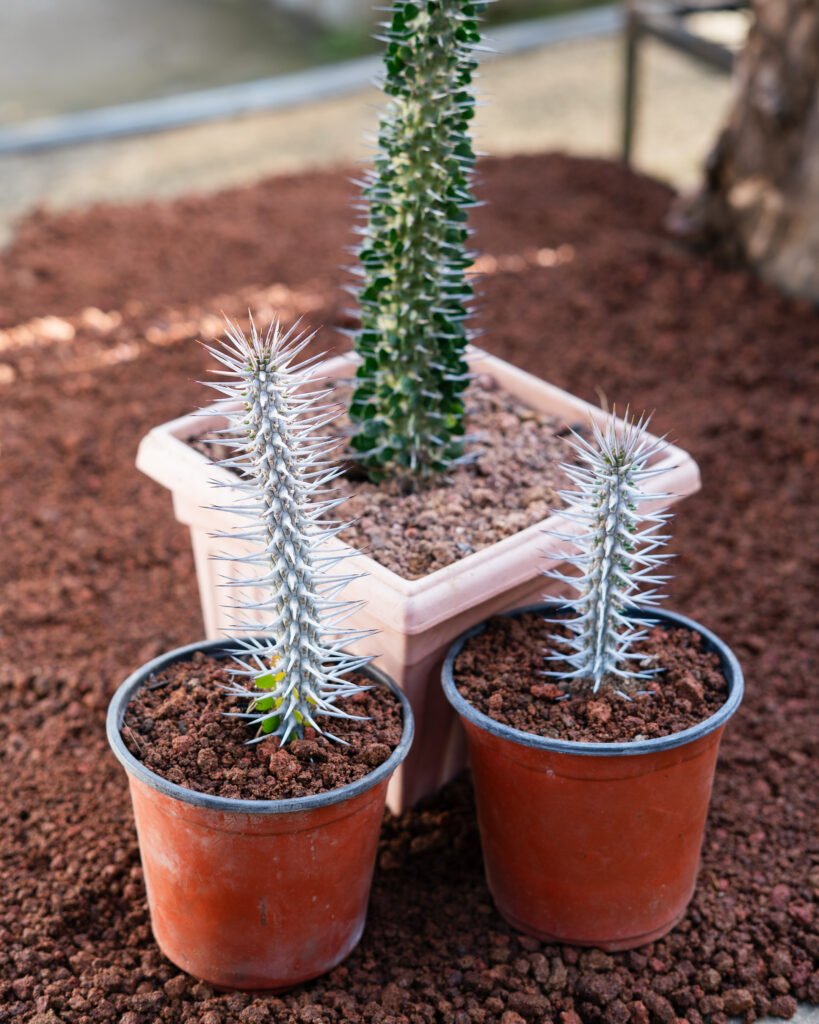
Photo Caption:
A cultivated Alluaudia procera showing its upright, heavily spined stem and small succulent leaves. Two smaller specimens in the foreground represent cuttings propagated from the parent plant.
Photography: John Niño G. Ewa (@_____.5am)
Picture Description
The photograph shows a tall, upright Alluaudia specimen growing in a rectangular container, accompanied by two smaller potted cuttings. The parent plant has a narrow, vertically oriented green-to-grey stem densely armed with sharp spines and carrying small green leaves between the spines. The cuttings display the characteristic pale, heavily spined juvenile stems.
The combination of pale cylindrical stems, persistent spines and small fleshy leaves arranged along the stem strongly supports identification as Alluaudia procera. Pl@ntUse
Plant Description
Alluaudia procera is a distinctive succulent tree of the dry regions of southern Madagascar. Young plants can appear as upright, somewhat shrub-like collections of stems, while mature specimens develop into tall, relatively narrow trees with a dominant trunk and elevated branches. Pl@ntUse
Its most recognizable feature is the pale grey-green to whitish stem covered with rows of sharp spines. During periods of active growth, small fleshy leaves emerge between the spines, giving the plant a striking contrast of green foliage against the pale, armored stem. Pl@ntUse
Basic Information
| Feature | Information |
|---|---|
| Scientific Name | Alluaudia procera (Drake) Drake |
| Family | Didiereaceae |
| Genus | Alluaudia |
| Plant Type | Succulent tree |
| Native Range | Southern Madagascar |
| Natural Environment | Desert and dry shrubland |
| Growth Form | Upright, columnar to tree-like |
| Foliage | Small, fleshy, deciduous leaves |
| Spines | Sharp, persistent, arranged along the stems |
| Propagation | Seeds and stem cuttings |
| Collection Status | Parent plant with two propagated cuttings |
Kew places the species in Didiereaceae and records its native range as southern Madagascar, particularly within desert or dry-shrubland environments. Plants of the World Online
Plant Overview
The Madagascar Ocotillo is one of the most visually distinctive members of the Didiereaceae. Its architecture is built around vertical stems that combine water-storing tissues with formidable defensive structures.
In cultivation, young plants can remain relatively compact for some time before developing the characteristic tall, tree-like form. Stem cuttings are capable of rooting, making vegetative propagation particularly useful for cultivated collections. Open Research Online
Botanical Description
Growth Habit
A succulent, deciduous tree that begins with upright stems and may develop a dominant central trunk as it matures. Young cultivated plants can be more freely branched and shrub-like, whereas mature plants become increasingly tree-like and vertically oriented. Pl@ntUse
Mature Size
In its native environment, Alluaudia procera can become a substantial tree, reaching approximately 15–18 m in height under favorable natural conditions. Cultivated specimens are generally much smaller, although they can eventually become several metres tall. Pl@ntUse
Stem
Stems are cylindrical, succulent and typically grey-green to bone-white. Young stems may be somewhat corrugated or irregular, becoming more substantial and woody with age. The stems carry regularly arranged spines and small leaves. Pl@ntUse
Leaves
Leaves are small, fleshy and generally oval to oblong. They arise directly or almost directly from the stem, commonly occurring in association with the spines. Leaves are most abundant during periods of favorable moisture and may be shed during prolonged dry conditions. Pl@ntUse
Spines
The stems are densely armed with sharp, persistent conical spines. They form conspicuous rows or tracks along the stem and remain after the leaves have fallen. Spines are typically around 1–2 cm long, although cultivated material may show considerable variation. Pl@ntUse
Roots
The plant develops a root system adapted to life in an arid environment, allowing it to make use of limited and irregular rainfall. As with other drought-adapted succulents, excellent drainage is important in cultivation.
Flowers
Flowers are small and inconspicuous individually, generally greenish-yellow to whitish. They are produced in clusters toward the ends of mature branches. Alluaudia procera is dioecious, meaning male and female flowers occur on separate plants. Pl@ntUse
Fruits
The female plant produces small, one-seeded fruits following flowering. Default
Seeds
Seeds are small and associated with the one-seeded fruit. Because the species is dioecious, seed production requires appropriate male and female plants. Default
Native Habitat
Geographic Distribution
Alluaudia procera is native to southern Madagascar. Plants of the World Online
Natural Ecosystem
It is associated with Madagascar’s dry southern vegetation, including arid and semi-arid landscapes and the island’s distinctive spiny forest communities. florafinder.org
Climate
The species is adapted to hot, dry conditions with seasonal and irregular rainfall. Its deciduous behavior allows it to reduce water loss during extended dry periods. Pl@ntUse
Cultivation & Care
Light
Provide bright light to full sun. Strong light helps maintain compact growth and the characteristic development of the heavily spined stems. Young plants may benefit from gradual acclimatization to intense direct sunlight. Port St. Lucie Botanical Gardens
Watering
Water thoroughly during active growth, then allow the growing medium to dry before watering again. Reduce watering substantially during cool or dormant periods.
Soil
Use a very free-draining succulent or cactus medium. The growing medium should not remain wet around the roots.
Temperature
Warm conditions are preferred. Protect the plant from prolonged cold and especially from freezing temperatures.
Fertilization
Feed lightly during the active growing season with a diluted fertilizer formulated for cacti or succulents. Avoid heavy fertilization.
Drainage
Excellent drainage is essential. Poorly drained soil combined with frequent watering can lead to root problems. Port St. Lucie Botanical Gardens
Propagation
Alluaudia procera can be propagated from stem cuttings and from seed. Stem cuttings are particularly useful in cultivation because suitable cuttings can root relatively readily. Open Research Online
The two small plants shown in Figure 1 are cuttings from the parent specimen, making this photograph a useful record of vegetative propagation within the Green Desert collection.
Interesting Facts
- Alluaudia procera belongs to Didiereaceae, a plant family strongly associated with Madagascar. Plants of the World Online
- It is not a cactus, despite its strongly cactus-like appearance.
- The species is related to other remarkable Madagascar plants such as Didierea and Alluaudia ascendens.
- Its common name “Madagascar Ocotillo” comes from its resemblance to the North American ocotillo, even though the two plants belong to unrelated plant families. florafinder.org
- The species is dioecious, so individual plants are functionally male or female. Default
- The plant’s pale stem and persistent spines remain highly conspicuous even when seasonal leaf loss leaves the plant largely bare.
- The species is recognized by Kew as an accepted species, with Didierea procera Drake treated as a synonym. Plants of the World Online
Life’s Whisper
“Even in the driest places, life finds a way to stand tall.”
Navigation
⬅ Previous Genus
🏠 Home — Botanical Library – Alluaudia Collection
➡ Next Genus
References
For the complete list of botanical references, scientific literature, and online resources used in preparing the Green Desert Botanical Library, please visit the References page available from the Main Menu.
🌵 GREEN DESERT BOTANICAL LIBRARY
WHERE EVERY PLANT HAS A STORY
DISCOVER THE STORY • GROW THE WONDER