
Plant ID
GD-CAC-009-0035
Common Name(s)
Persian Carpet Flower
Plant Photograph
Photograph: Green Desert Botanical Library specimen photograph.
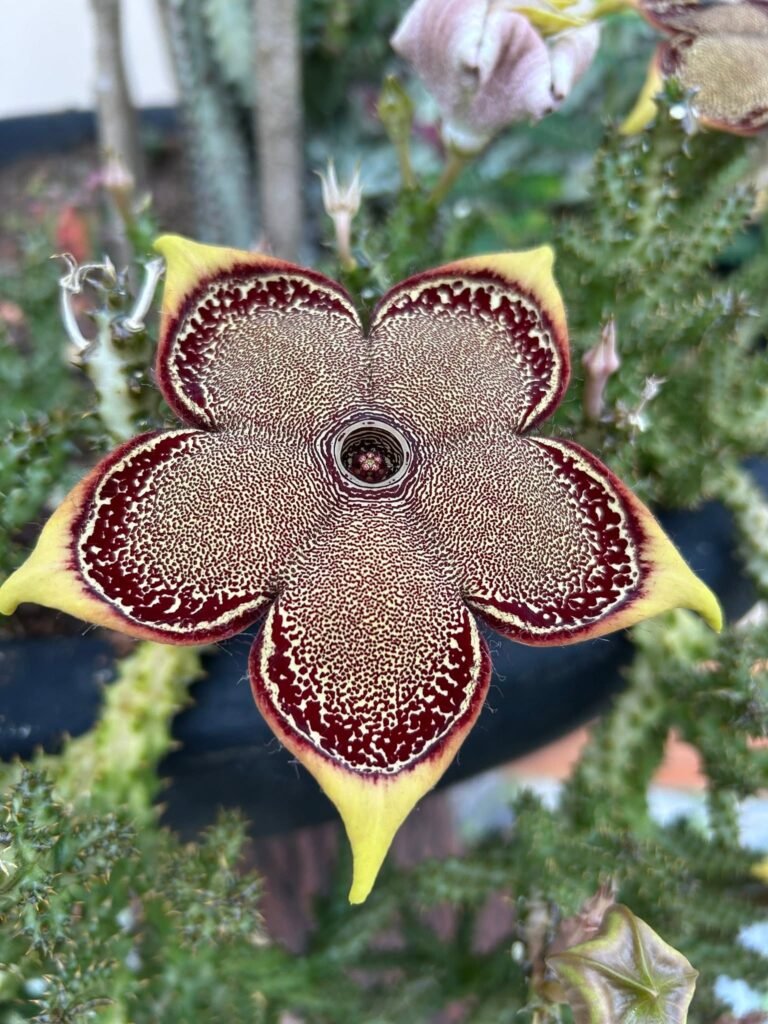
Picture Description
Photography: Green Desert Botanical Liibrary
The photograph features the spectacular flower of Edithcolea grandis, displaying five broad, yellow-cream lobes covered with an intricate pattern of dark maroon to reddish-brown markings.
The flower has a distinctive concentric pattern toward the center, with a small central reproductive structure surrounded by a prominent ring-like structure. The margins of the lobes are darker and finely fringed with hairs.
The remarkable combination of colors and intricate markings gives the flower its evocative common name, Persian Carpet Flower.
Plant Description
Edithcolea grandis is a leafless, succulent, creeping and highly branched plant in the family Apocynaceae. It has cactus-like stems but is not a cactus.
The stems are green to gray-green and usually four- to five-angled, with small, hard, pointed teeth along the angles. The plant can spread along the ground and form a mat or cushion.
Its extraordinary flowers are the principal attraction. The flowers are large, fleshy, rotate-shaped, and usually creamish-yellow with elaborate purplish-red to red-brown markings. Kew records flowers approximately 8–12 cm in diameter.
Basic Information
Scientific Name: Edithcolea grandis N.E.Br.
Kingdom: Plantae
Phylum: Streptophyta
Class: Equisetopsida
Order: Gentianales
Family: Apocynaceae
Genus: Edithcolea
Species: Edithcolea grandis
Plant Type: Succulent stem plant
Growth Form: Creeping, branching, mat-forming
Stem Color: Green to gray-green, sometimes reddish with brownish markings
Flower Type: Large, rotate-shaped, five-lobed flower
Flower Color: Creamish-yellow with purplish-red to red-brown markings
Native Range: Eastern and northeastern tropical Africa, Socotra, and Yemen
Edithcolea grandis is the accepted species and the sole accepted species in the genus Edithcolea according to Kew’s Plants of the World Online.
Plant Overview
Edithcolea grandis is one of the most unusual and visually remarkable succulent plants in the Green Desert Botanical Library.
Its creeping stems are relatively inconspicuous compared with its enormous and intricately patterned flowers. When in bloom, the plant produces a remarkable floral display resembling an elaborate piece of woven fabric or carpet.
The flower is particularly distinctive for its five broad lobes, intricate dark markings, concentric central pattern, and hairy margins. The flowers may also produce a carrion-like scent that attracts flies and other insects for pollination.
Botanical Description
Growth Habit
A perennial, leafless, succulent stem plant with a creeping, branching and mat-forming habit.
The stems may root adventitiously and spread across the ground, eventually forming broad cushions or mats.
Mature Size
The stems are generally about 2–4 cm in diameter and may reach approximately 30 cm in length, although larger plants can spread considerably as the stems branch and root.
Stem
The stems are green or gray-green and cylindrical to roundedly four- or five-angled.
The angles bear regularly arranged conical tubercles or hard, pointed, tooth-like structures. Brownish or reddish markings may occur around these structures.
Leaves
True leaves are absent.
Small, reduced leaf rudiments occur on the stems but are highly modified and inconspicuous.
Spines
The plant does not possess true cactus spines.
Instead, the stem angles bear hard, acute, spine-like teeth or tubercles. These structures give the plant a cactus-like appearance.
Roots
The plant develops roots along its stems and may root adventitiously as it spreads across the ground.
This rooting habit helps the plant establish broad mats and absorb available moisture from its dry natural environment.
Flowers
The flowers are the most spectacular feature of Edithcolea grandis.
They are large, fleshy and rotate-shaped, measuring approximately 8–12 cm across. The base color is creamish-yellow and is covered with intricate purplish-red to red-brown markings.
The five corolla lobes are broad and triangular, with darker markings becoming particularly concentrated toward their bases and margins. The flower also possesses a distinctive central corona surrounding the reproductive structures.
The margins of the flower are furnished with characteristic hairs or trichomes.
Fruits
Following successful pollination, the plant produces paired elongated follicles.
Kew records the fruits as two fusiform, winged mericarps that can reach approximately 9–20 cm in length.
Seeds
The seeds are broadly ovate and possess a wing-like margin. They are adapted for dispersal after the mature fruit opens.
Native Habitat
Geographic Distribution
Edithcolea grandis is native to Djibouti, Ethiopia, Kenya, Somalia, Tanzania, Socotra, Uganda, and Yemen. Kew gives the broader native range as Ethiopia to Tanzania, Socotra and Yemen.
Natural Ecosystem
The species grows primarily in desert and dry shrubland environments.
It is associated with dry, deciduous bushland and is commonly found on rocky ground. Kew records it from approximately 400–1,350 meters elevation in the Flora of Tropical East Africa treatment.
Climate
Its natural habitat experiences warm conditions and seasonal dryness.
The succulent stems allow the plant to conserve water during dry periods, while its creeping growth habit enables it to occupy rocky and exposed ground.
Cultivation & Care
Light
Provide bright light to partial sun.
Morning sunlight and bright filtered light are suitable. In very hot climates, protection from intense afternoon sunlight can help prevent scorching.
Watering
Water thoroughly during active growth, then allow the growing medium to dry before watering again.
Reduce watering during cooler or dormant periods.
Avoid prolonged wetness around the roots.
Soil
Use a very well-draining succulent medium.
A mineral-rich mixture containing pumice, lava rock, coarse sand, perlite, and a modest amount of organic material is appropriate.
Temperature
Provide warm growing conditions with good air circulation.
Protect the plant from prolonged cold, particularly when the soil is wet.
Fertilization
Apply a diluted fertilizer formulated for succulents during active growth.
Avoid excessive fertilization, particularly excessive nitrogen.
Drainage
Excellent drainage is essential.
The roots should never remain in stagnant or waterlogged soil.
Propagation
Edithcolea grandis can be propagated through stem cuttings and seeds.
Stem Cuttings
- Select a healthy stem.
- Make a clean cut using a sterile tool.
- Allow the cutting to dry and callus.
- Place it in a porous, well-draining succulent medium.
- Keep the medium relatively dry until rooting begins.
- Gradually introduce watering once roots develop.
Seed Propagation
Seeds can be sown in a clean, porous propagation medium and maintained under warm conditions with careful moisture control.
Interesting Facts
- Edithcolea grandis is the sole accepted species of the genus Edithcolea according to Kew.
- The plant is a succulent but not a cactus; it belongs to the family Apocynaceae.
- Its common name Persian Carpet Flower refers to the extraordinary intricate pattern of its large flowers.
- Flowers can reach approximately 8–12 cm across.
- The flowers may have a carrion-like scent that attracts flies and other insects for pollination.
- The stems are leafless and have hard, tooth-like structures along their angles.
- The plant can spread by rooting along its creeping stems and form large mats.
- The species occurs naturally across parts of eastern Africa, Socotra and the Arabian Peninsula.
- The genus Edithcolea was named in honor of Edith Cole, who collected the type material with Lort Phillips in Somaliland.
Life’s Whisper
“Nature turns every detail into a masterpiece.”
Navigation
⬅ Previous Genus: [Previous Genus]
🏠 Home: Botanical Library – Edithcolea Collection
➡ Next Genus: [Next Genus]
References
For the complete list of botanical references, scientific literature, and online resources used in preparing the Green Desert Botanical Library, please visit the References page available from the Main Menu.
🌵 Green Desert Botanical Library
Where Every Plant Has a Story to Tell.
Discover the Story. Grow the Wonder.