
Plant ID
GD-CAC-600-0030
Identification Status: Provisional identification based on the submitted photograph.
Common Name(s)
Queen of the Night
Night-Blooming Cereus
Large-Flowered Cactus
Vanilla Cactus
Plant Photograph
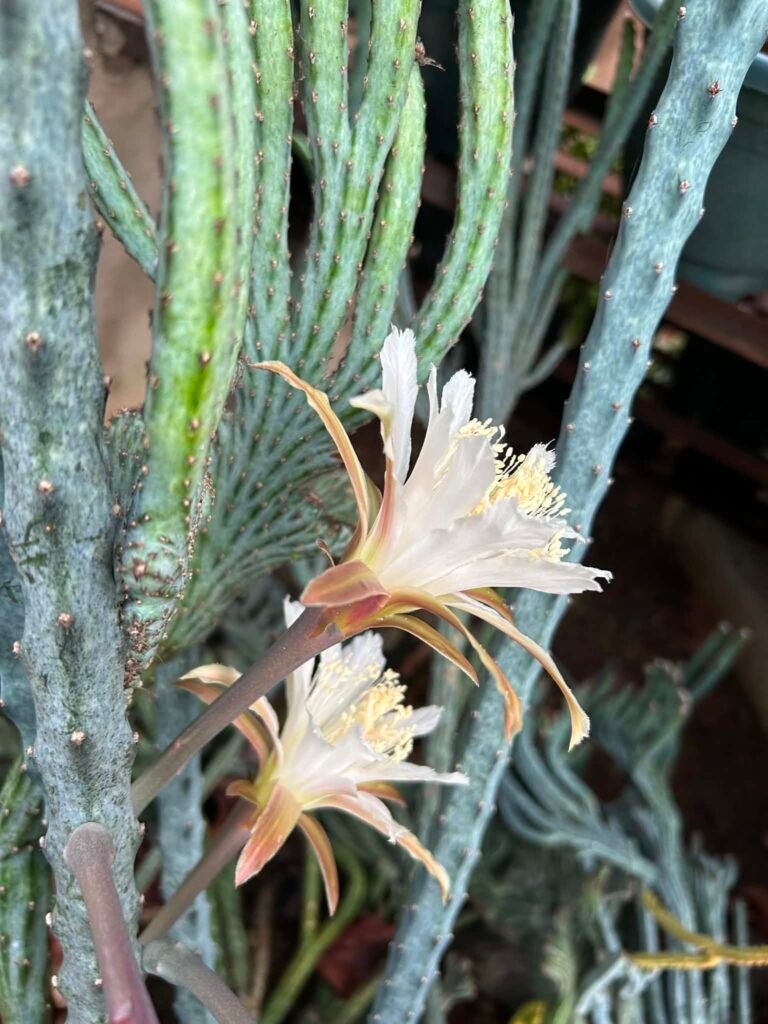
Photograph: Green Desert Botanical Library specimen photograph.
Picture Description
The photograph shows a mature, branching cactus with numerous slender, elongated green to bluish-green stems. The stems are ribbed and carry small areoles arranged along their margins.
Two large flowers are visible emerging from the stems. The flowers have long, narrow tubes with reddish-brown to purplish outer segments and broad, delicate white inner segments. Numerous pale-yellow stamens extend prominently from the flower centers.
The combination of slender ribbed stems and large white flowers with colored outer segments is characteristic of a night-blooming Selenicereus.
Plant Description
Selenicereus grandiflorus is a climbing or epiphytic cactus known for its spectacular, large, fragrant flowers that open at night.
The plant develops long, slender, branching stems that may trail, climb, or grow over rocks and trees. Its stems can become several meters long and may produce aerial or adventitious roots that help the plant attach to supporting surfaces.
The flowers are among its most remarkable features. They have a long floral tube and a broad, funnel-shaped flower with white inner segments and darker outer segments. The flowers are adapted for nocturnal pollination.
Basic Information
Scientific Name: Selenicereus grandiflorus (L.) Britton & Rose
Kingdom: Plantae
Phylum: Streptophyta
Class: Equisetopsida
Order: Caryophyllales
Family: Cactaceae
Genus: Selenicereus
Species: Selenicereus grandiflorus
Plant Type: Epiphytic / climbing cactus
Growth Form: Trailing, climbing, branching
Spines: Short to slender, borne on small areoles
Native Range: Mexico to Guatemala and the northern Caribbean
Natural Biome: Seasonally dry tropical environments
Plant Overview
Selenicereus grandiflorus is a fascinating cactus because its appearance is very different from the familiar rounded or columnar desert cacti.
Instead of developing a single thick body, it produces long, flexible stems that climb over trees, rocks, or other supports. The stems can form tangled masses as the plant matures.
Its greatest attraction is its enormous night-opening flower. The flowers are large in relation to the slender stems and may open for only a short period, making the flowering event especially memorable.
Botanical Description
Growth Habit
A branching, trailing, clambering, or climbing cactus.
The stems may grow along the ground, climb over vegetation and rocks, or develop as an epiphyte. Mature plants can form extensive tangles of stems.
Mature Size
The stems may reach several meters in length, with Kew reporting stems reaching approximately 10 meters or more in some plants.
Individual stems are comparatively slender, commonly around 1–2.5 cm in diameter.
Stem
The stems are green to bluish-green and may become somewhat purplish along the ribs.
They are elongated and ribbed, commonly with approximately 5–8 low ribs.
Small areoles occur along the ribs and carry the plant’s short spines.
Leaves
True leaves are absent.
The green stems perform photosynthesis and also provide structural support and limited water storage.
Spines
The areoles produce relatively small, needle-like spines.
Spines may be whitish to brownish and are generally much less conspicuous than those of many barrel or columnar cacti.
Young growth may have fewer and shorter spines.
Roots
The plant can develop both terrestrial roots and adventitious or aerial roots.
Aerial roots assist the climbing habit and allow stems to attach to trees, rocks, or other supporting structures.
Flowers
The flowers are the defining feature of the species.
They are large, white, funnel-shaped, and primarily nocturnal. The flower tube is long and is covered with scales, hairs, and bristles.
The outer flower segments may be brownish, reddish, orange, or yellowish, while the inner segments are predominantly white.
Numerous stamens extend from the center, creating the characteristic full, brush-like appearance visible in the photograph.
Fruits
After successful pollination, the plant produces an ovoid fruit that may reach approximately 8 cm in length.
Seeds
The fruits contain numerous small seeds.
Seed propagation is possible, although established plants are also commonly maintained vegetatively in cultivation.
Native Habitat
Geographic Distribution
Selenicereus grandiflorus has a native range extending from Mexico through Guatemala and into the northern Caribbean.
Kew records the species from Mexico, Belize, Guatemala, Honduras, Nicaragua, Cuba, Jamaica, Haiti, the Dominican Republic, the Cayman Islands, and the Bahamas, among other areas.
Natural Ecosystem
The species is primarily associated with seasonally dry tropical environments.
It can grow as an epiphyte on trees, as a climbing plant, or in association with rocks and other supporting structures.
Climate
It naturally experiences warm tropical or subtropical conditions with seasonal periods of rainfall and dryness.
The plant benefits from warmth, good air movement, and access to moisture while avoiding prolonged saturation around its roots.
Cultivation & Care
Light
Provide bright light with filtered sunlight or several hours of gentle direct sunlight.
Strong morning or late-afternoon light is beneficial. Plants should be acclimatized gradually when moved into stronger sunlight.
Watering
Water thoroughly during active growth and allow excess water to drain freely.
Allow the growing medium to become partially dry before watering again.
Reduce watering during cooler or less active periods, while avoiding prolonged extreme dryness in actively growing plants.
Soil
Use a well-draining but organic-rich cactus medium.
Unlike many strictly terrestrial desert cacti, Selenicereus benefits from a growing medium that contains some organic matter while still providing excellent drainage.
Temperature
Provide warm growing conditions.
Protect the plant from prolonged exposure to low temperatures, particularly when the growing medium is wet.
Fertilization
Apply a diluted, balanced fertilizer during active growth.
Regular but moderate feeding can support vigorous stem development and flowering.
Drainage
Excellent drainage remains essential.
Although this species appreciates more moisture and organic matter than many desert cacti, water should never remain stagnant around the roots.
Propagation
Selenicereus grandiflorus can be propagated through stem cuttings or seeds.
Stem Cuttings
- Select a healthy mature stem.
- Cut a suitable section using a clean tool.
- Allow the cut surface to dry and callus.
- Place the cutting in a porous, well-draining medium.
- Keep the medium relatively dry initially.
- Gradually introduce watering once rooting begins.
- Provide bright light and warm conditions during establishment.
Seed Propagation
Seeds may also be sown in a clean, well-draining propagation medium and maintained under warm, humid conditions until germination.
Interesting Facts
- The common name Queen of the Night refers to its spectacular nocturnal flowering.
- The flowers are large compared with the slender stems of the plant.
- The flowers are adapted to opening at night.
- The species may grow as an epiphyte, climbing over trees and other supporting structures.
- Its stems can become many meters long.
- The genus name Selenicereus is associated with the moon, reflecting the nocturnal flowering behavior of many members of the genus.
- The species is currently accepted by the Royal Botanic Gardens, Kew.
- Selenicereus grandiflorus is sometimes confused in cultivation with other large-flowered night-blooming cacti.
- The true species is considered relatively uncommon in cultivation, with plants sold under the name sometimes representing other related species or hybrids.
Life’s Whisper
🌙 “Some wonders reveal themselves only when the world grows quiet.”
Navigation
⬅ Previous Genus: Ferocactus
🏠 Home: Botanical Library – Selenicereus Collection
➡ Next Genus: [Next Genus]
References
For the complete list of botanical references, scientific literature, and online resources used in preparing the Green Desert Botanical Library, please visit the References page available from the Main Menu.
🌵 Green Desert Botanical Library
Where Every Plant Has a Story to Tell.
Discover the Story. Grow the Wonder.