
Plant ID
GD-CAC-004-0026
Scientific Name: Astrophytum myriostigma Lem.
Identification Status: Provisional identification based on the submitted photograph.
Common Name(s)
Bishop’s Mitre Cactus
Bishop’s Cap Cactus
Bishop’s Hat Cactus
Monk’s Hood Cactus
Plant Photograph
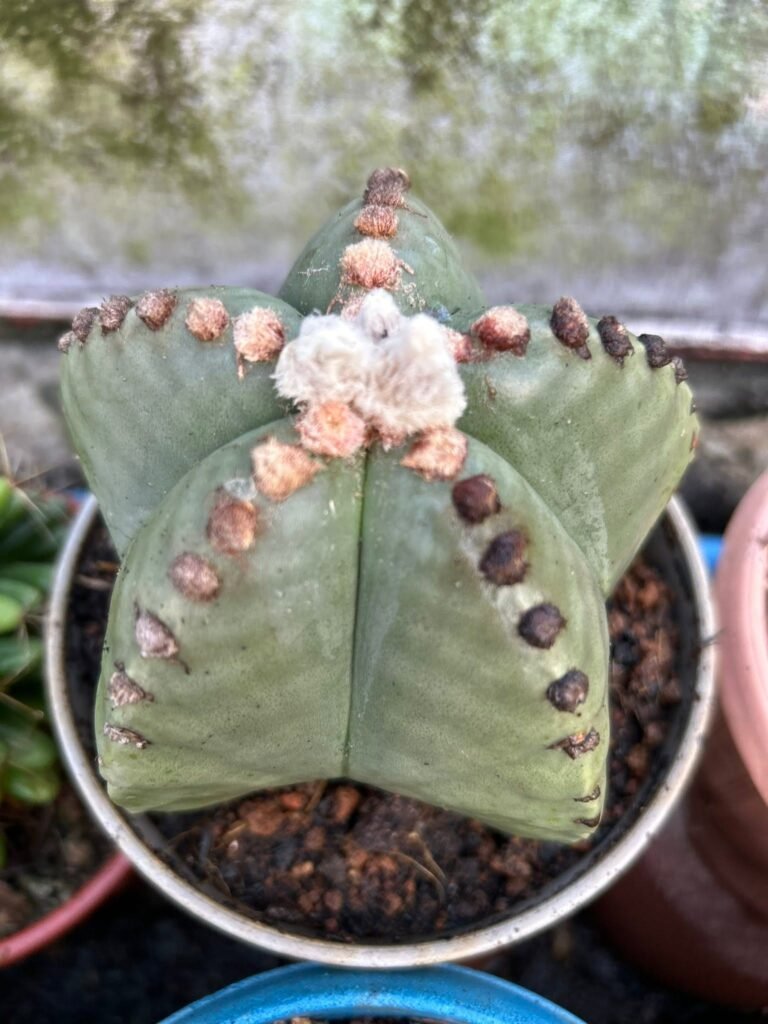
Photograph: Green Desert Botanical Library specimen photograph.
Picture Description
The photograph shows a compact, green Astrophytum cactus with a distinctly ribbed, symmetrical body. The specimen has a smooth, spineless epidermis with prominent ribs rising toward the apex.
Numerous woolly areoles are arranged along the ribs. These areoles appear tan to brown, with a conspicuous mass of white wool concentrated near the growing point.
The body is green to gray-green and shows relatively little of the dense white speckling commonly associated with some forms of Astrophytum myriostigma. The absence of prominent spines and the strongly defined ribs are important features supporting the identification.
Plant Description
Astrophytum myriostigma is a highly recognizable cactus characterized by its geometric, ribbed body and lack of prominent spines. Young plants are generally globular, gradually becoming more upright and shortly columnar with age.
The species is particularly admired for its architectural symmetry. Its ribs create a distinctive star-like or bishop’s-mitre silhouette, while the woolly areoles provide texture along the rib margins.
The species is variable in appearance, with some plants displaying abundant white scales and others showing a much greener or comparatively bare epidermis. The specimen photographed here has a predominantly green appearance with clearly visible brownish woolly areoles.
Astrophytum myriostigma is currently accepted as a species by the Royal Botanic Gardens, Kew. Its native range is northeastern Mexico.
Basic Information
Kingdom: Plantae
Phylum: Streptophyta
Class: Equisetopsida
Order: Caryophyllales
Family: Cactaceae
Genus: Astrophytum
Species: Astrophytum myriostigma
Plant Type: Cactus / succulent
Growth Form: Globular to shortly columnar
Spines: Absent or essentially spineless
Native Country: Mexico
Native Range: Northeastern Mexico
Natural Biome: Desert and dry shrubland
Kew recognizes Astrophytum myriostigma as an accepted species and currently recognizes two accepted infraspecific taxa within it.
Plant Overview
Astrophytum myriostigma is one of the classic collector’s cacti of the genus Astrophytum. Its most immediately recognizable feature is its strongly ribbed body, which gives the plant a geometric, almost sculptural appearance.
Unlike Astrophytum ornatum, which is conspicuously spined, A. myriostigma is characteristically spineless. This makes the woolly areoles and rib structure particularly important visual features.
The species is commonly described as forming a spherical or shortly columnar gray-green plant, reaching around 20 cm in height in the RHS cultivation profile.
The specimen in the photograph is especially interesting because its green epidermis is relatively clean and the woolly areoles stand out prominently against the body.
Botanical Description
Growth Habit
A solitary, slow-growing cactus that begins as a rounded or globular plant and gradually becomes more upright and shortly columnar with maturity.
The body is strongly ribbed, giving the plant its characteristic architectural form. The number and arrangement of ribs may vary among plants and forms.
Mature Size
In cultivation, plants may reach approximately 20 cm in height, although size can vary depending on growing conditions and genetic form.
Stem
The stem is fleshy, green to gray-green, globular when young and becoming shortly columnar with age.
The ribs are broad and prominent, producing a symmetrical, angular appearance. The epidermis may be covered with varying amounts of tiny whitish scales.
Leaves
True leaves are absent.
The green stem performs photosynthesis and serves as the plant’s principal water-storage organ.
Spines
The species is characteristically spineless.
Instead of prominent protective spines, the plant has woolly areoles positioned along the ribs. This lack of spines is one of the useful features distinguishing A. myriostigma from heavily spined members of the genus such as A. ornatum.
Roots
The plant develops roots adapted to rapidly absorb available moisture from well-drained soil.
Roots are vulnerable to prolonged saturation, making excellent drainage particularly important in cultivation.
Flowers
Mature plants produce attractive yellow flowers, generally appearing near the apex during the warmer growing season.
Flowers are funnel-shaped and may reach approximately 5 cm across. Some flowers can have a reddish center.
Fruits
After successful pollination, flowers develop into small fruits containing numerous seeds.
The fruits contribute to the plant’s natural reproductive cycle and eventually release seeds that can establish new plants.
Seeds
Seeds are small and are the principal means of propagation.
Fresh, viable seed can be germinated under warm, carefully controlled conditions.
Native Habitat
Geographic Distribution
Astrophytum myriostigma is native to northeastern Mexico.
Natural Ecosystem
The species grows primarily in desert and dry shrubland environments, where plants experience strong sunlight, seasonal moisture, and periods of dryness.
Its specialized succulent body enables it to store water and survive in environments where water availability can be unpredictable.
Climate
Its natural environment is characterized by warm conditions, intense sunlight, seasonal rainfall, and relatively dry periods.
These conditions explain the species’ preference for strong light, rapid drainage, and controlled watering when cultivated.
Cultivation & Care
Light
Provide bright light to full sun.
When moving a plant from shade or greenhouse conditions into stronger sunlight, acclimatize it gradually to reduce the risk of sunburn.
Watering
Water thoroughly during active growth, allowing the growing medium to become dry before watering again.
During cooler or dormant periods, substantially reduce watering and keep the plant relatively dry.
The principal danger is prolonged moisture around the roots.
Soil
Use a very well-draining cactus and succulent medium.
A mineral-rich mixture containing pumice, lava rock, coarse sand, perlite, or similar porous materials is appropriate.
A slightly alkaline or neutral medium with excellent drainage is suitable for cultivation. The RHS recommends well-drained conditions and notes that the species can be grown in cactus compost with added limestone chippings.
Temperature
The plant prefers warm growing conditions.
Protect it from prolonged cold, especially when the growing medium is wet. Cold combined with excess moisture can increase the risk of root problems.
Fertilization
Apply a diluted cactus fertilizer during active growth.
Avoid excessive nitrogen because overly vigorous, soft growth can reduce the compact character that makes the plant attractive.
Drainage
Excellent drainage is essential.
Use a pot with adequate drainage holes and never allow water to remain trapped around the roots.
Propagation
Astrophytum myriostigma is primarily propagated by seed.
Seed Propagation
- Use fresh, viable seeds.
- Sow the seeds on a clean, porous cactus propagation medium.
- Keep the medium lightly moist during germination.
- Provide warmth and bright filtered light.
- Maintain good ventilation.
- Avoid prolonged saturation.
- Gradually reduce moisture as seedlings become established.
- Transplant carefully once the young plants are sufficiently developed.
The RHS recommends propagation by seed, with sowing at approximately 21°C (70°F) in early spring.
Interesting Facts
- Astrophytum myriostigma is one of the best-known species of the genus Astrophytum.
- Its common name Bishop’s Mitre refers to the distinctive shape created by its prominent ribs.
- The plant is characteristically spineless, relying on its body structure and other adaptations rather than long spines for protection.
- The amount of white scaling can vary considerably between plants.
- Some forms have a heavily speckled appearance, while others can appear predominantly green, like the specimen shown in this photograph.
- The species can begin as a rounded cactus and gradually become more upright with age.
- Its yellow flowers provide a striking contrast against the green body.
- Kew currently recognizes Astrophytum myriostigma as an accepted species within the genus Astrophytum.
Life’s Whisper
🌵 “You do not need thorns to be strong.”
This cactus carries a quiet kind of strength.
It does not surround itself with long, threatening spines. Instead, it stands protected by its form—firm, resilient, and beautifully structured.
Its ribs rise gently toward the light, creating order where we might first see only simplicity.
Perhaps life teaches us something similar.
Strength is not always loud.
Protection is not always sharp.
And beauty does not always need to demand attention.
Sometimes, the strongest things simply stand their ground and continue to grow.
Life’s whisper:
You can be gentle and still be strong. You can be quiet and still be remarkable.
Navigation
⬅ Previous Genus: Echinocactus
🏠 Home: Botanical Library – Astrophytum Collection
➡ Next Genus: Gymnocalycium
References
For the complete list of botanical references, scientific literature, and online resources used in preparing the Green Desert Botanical Library, please visit the References page available from the Main Menu.
🌵 Green Desert Botanical Library
Where Every Plant Has a Story to Tell.
Discover the Story. Grow the Wonder.