
Plant ID
GD-CAC-004-0025
Scientific Name: Astrophytum ornatum (DC.) Britton & Rose
Common Name(s)
Monk’s Hood Cactus
Bishop’s Cap Cactus
Star Cactus
Plant Photograph
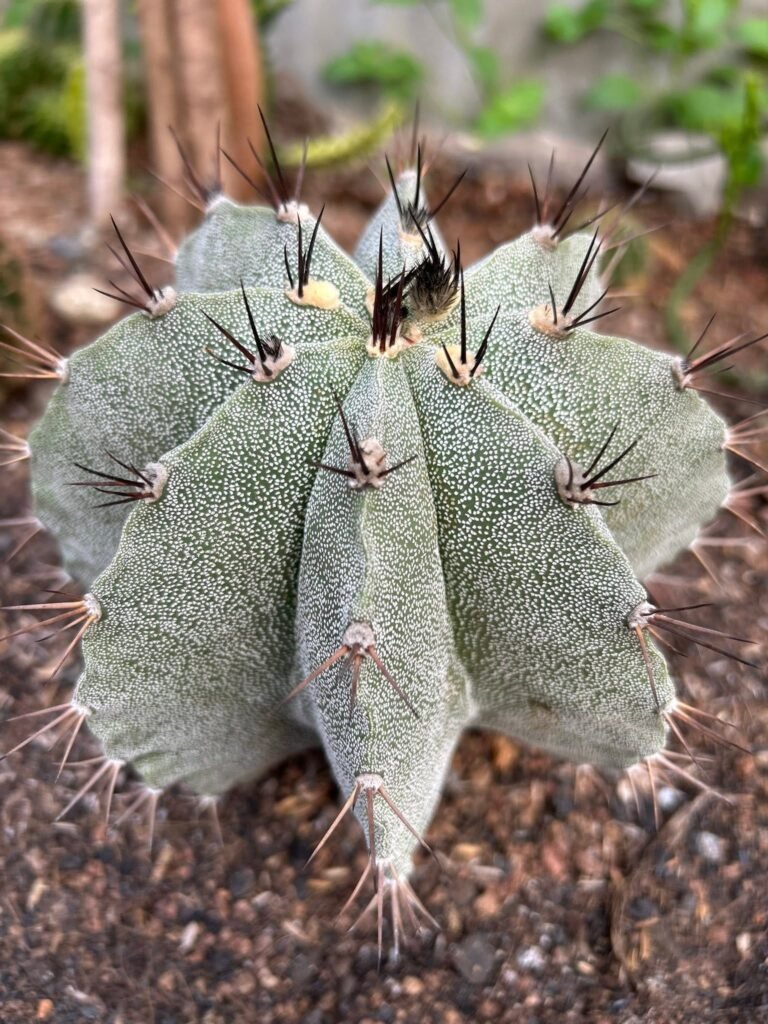
Photograph: Green Desert Botanical Library specimen photograph.
Picture Description
The photograph presents a striking Astrophytum cactus viewed from above. The plant has a strongly star-shaped body formed by prominent ribs. Its green surface is densely covered with tiny white scales, producing a silvery, speckled appearance.
Woolly areoles are clearly visible along the ribs, with clusters of long, slender spines extending outward. The spines range from dark brown to reddish-brown, contrasting strongly with the pale, finely marked body.
The specimen’s combination of pronounced ribs, dense white scales, woolly areoles, and prominent spines is characteristic of Astrophytum ornatum.
Plant Description
Astrophytum ornatum is a distinctive ribbed cactus of the family Cactaceae. It begins life with a more rounded form and gradually develops a taller, cylindrical or columnar body as it matures.
The species is particularly admired for its architectural form. From above, the ribs create a symmetrical star-like outline, while the white scales across the green epidermis give the plant an ornate, almost patterned appearance.
Unlike the commonly cultivated spineless Astrophytum myriostigma, A. ornatum normally develops conspicuous spines. Its combination of white markings and long spines makes it one of the most recognizable members of the genus.
Basic Information
Kingdom: Plantae
Phylum: Streptophyta
Class: Equisetopsida
Order: Caryophyllales
Family: Cactaceae
Genus: Astrophytum
Species: Astrophytum ornatum
Plant Type: Cactus
Growth Form: Solitary, globular to columnar
Native Country: Mexico
Native Range: Northeastern Mexico to Veracruz
Natural Biome: Desert and dry shrubland
Kew’s Plants of the World Online currently recognizes Astrophytum ornatum as an accepted species.
Plant Overview
Astrophytum ornatum is one of the largest and most strongly spined species in the genus Astrophytum. Young plants are generally rounded, while mature plants become increasingly cylindrical or columnar.
The species is easily recognized by its prominent ribs, white woolly scales, close-set areoles, and brownish or yellowish spines. The white scales may initially appear as numerous small flecks and can become more banded with age.
The specimen in this photograph is especially attractive because of the dense white covering of the ribs and the long, dark spines radiating from each areole.
Botanical Description
Growth Habit
A solitary cactus that develops from a rounded or globular juvenile form into a more upright, cylindrical to columnar plant with age.
The body commonly has 6–8 prominent ribs, although the species can show variation. The ribs may be straight or occasionally spiral.
Mature Size
Mature plants can reach approximately 35 cm in height under cultivated conditions, although larger specimens may develop in favorable environments. The species is regarded as the largest species within the genus Astrophytum.
Stem
The stem is green to gray-green, initially spherical and becoming cylindrical or columnar with age.
Its ribs are prominent and strongly defined. The epidermis is covered with numerous whitish scales that may form attractive cross-bands or irregular patterns.
Leaves
True leaves are absent.
As a cactus, the stem performs photosynthesis and is highly adapted for storing water during periods of environmental dryness.
Spines
The areoles produce conspicuous spines that may be yellowish, amber, reddish-brown, or dark brown with age.
Typically, several radial spines are accompanied by a larger central spine. Published descriptions report approximately 5–11 radial spines, generally accompanied by one larger central spine.
The specimen photographed displays particularly long, dark spines, making this feature one of its most noticeable characteristics.
Roots
The plant develops a specialized root system adapted to dry environments. Roots are sensitive to prolonged waterlogging, making a porous, rapidly draining growing medium essential in cultivation.
Flowers
Flowers are produced near the growing apex and are generally pale to lemon-yellow.
They are relatively large compared with the body of the cactus and may reach approximately 7–12 cm across according to published botanical descriptions. Flowering generally occurs during the warmer growing season.
Fruits
Following successful pollination, the plant develops small, rounded fruits containing numerous seeds.
Seeds
The seeds are small and numerous and provide the principal means of propagation for the species.
Native Habitat
Geographic Distribution
Astrophytum ornatum is native to Mexico, with its accepted native range extending from northeastern Mexico to Veracruz.
The species is particularly associated with east-central Mexico, including areas such as Querétaro and Hidalgo.
Natural Ecosystem
It grows primarily in desert and dry shrubland environments, where it experiences periods of strong sunlight and seasonal dryness.
Its natural habitat can include rocky and relatively exposed areas where rapid drainage prevents prolonged saturation of the root zone.
Climate
The species is adapted to warm, sunny conditions with periods of limited rainfall.
Its natural environment favors excellent drainage, strong light, and alternating periods of moisture and dryness.
Cultivation & Care
Light
Provide bright light to full sun.
Plants grown under shade should be gradually acclimatized before being exposed to intense direct sunlight to prevent sunburn.
Watering
Water thoroughly during active growth, then allow the growing medium to dry before watering again.
During cooler or dormant periods, watering should be greatly reduced.
The most important rule is to avoid keeping the roots continuously wet.
Soil
Use a very well-draining cactus and succulent medium.
A mineral-rich mixture containing materials such as pumice, lava rock, coarse sand, perlite, or other porous components is ideal.
Temperature
The plant prefers warm conditions and good air circulation.
Protection should be provided from prolonged cold, particularly when combined with wet soil.
Fertilization
Apply a diluted, balanced cactus fertilizer during active growth.
Avoid excessive nitrogen, which can encourage soft, weak growth.
Drainage
Excellent drainage is essential.
Use a container with adequate drainage holes and never allow the plant to remain standing in water.
Propagation
Astrophytum ornatum is primarily propagated by seed.
Seed Propagation
- Use fresh, viable seeds.
- Sow them on a clean, porous cactus propagation medium.
- Keep the medium lightly moist during germination.
- Provide warmth and bright, indirect light.
- Maintain good ventilation.
- Gradually reduce moisture as seedlings become established.
- Transplant carefully once the young plants are sufficiently developed.
Seed propagation also preserves genetic variation within the species.
Interesting Facts
- The genus name Astrophytum is derived from Greek words associated with star and plant, referring to the star-like appearance of the ribbed body.
- Astrophytum ornatum is considered the largest species in the genus.
- Its white scales provide the plant with its characteristic ornamental, speckled appearance.
- The white markings may become more banded as the plant matures.
- It is generally much more heavily spined than Astrophytum myriostigma.
- The plant may begin as a rounded cactus and gradually become columnar with age.
- Its strongly ribbed body produces a beautiful star-shaped pattern when viewed from above.
- The species is widely cultivated as an ornamental cactus and is highly valued by collectors.
Life’s Whisper
🌵 “Grow into the shape that only you can become.”
This cactus does not rush its transformation.
It begins close to the earth, rounded and compact, then slowly rises toward the light. Its ribs give it structure. Its spines give it protection. Its white markings give it beauty.
What appears to be a simple cactus from a distance reveals an intricate design when we take the time to look closely.
Perhaps life is much the same.
We do not have to become someone else to become beautiful.
We simply need to keep growing into the person we were meant to be.
Life’s whisper:
Your journey may be slow, but every season is shaping the wonder you are becoming.
Navigation
⬅ Previous Genus: [Previous Genus]
🏠 Home: Botanical Library – Astrophytum Collection
➡ Next Genus: [Next Genus]
References
For the complete list of botanical references, scientific literature, and online resources used in preparing the Green Desert Botanical Library, please visit the References page available from the Main Menu.
🌵 Green Desert Botanical Library
Where Every Plant Has a Story to Tell.
Discover the Story. Grow the Wonder.