
Plant ID
GD-CAC-100-0023
Common Name(s)
- Golden Barrel Cactus
- Golden Barrel
- Golden Ball Cactus
- Mother-in-Law’s Seat
Plant Photograph
📷 Figure 1. Echinocactus grusonii Hildm.
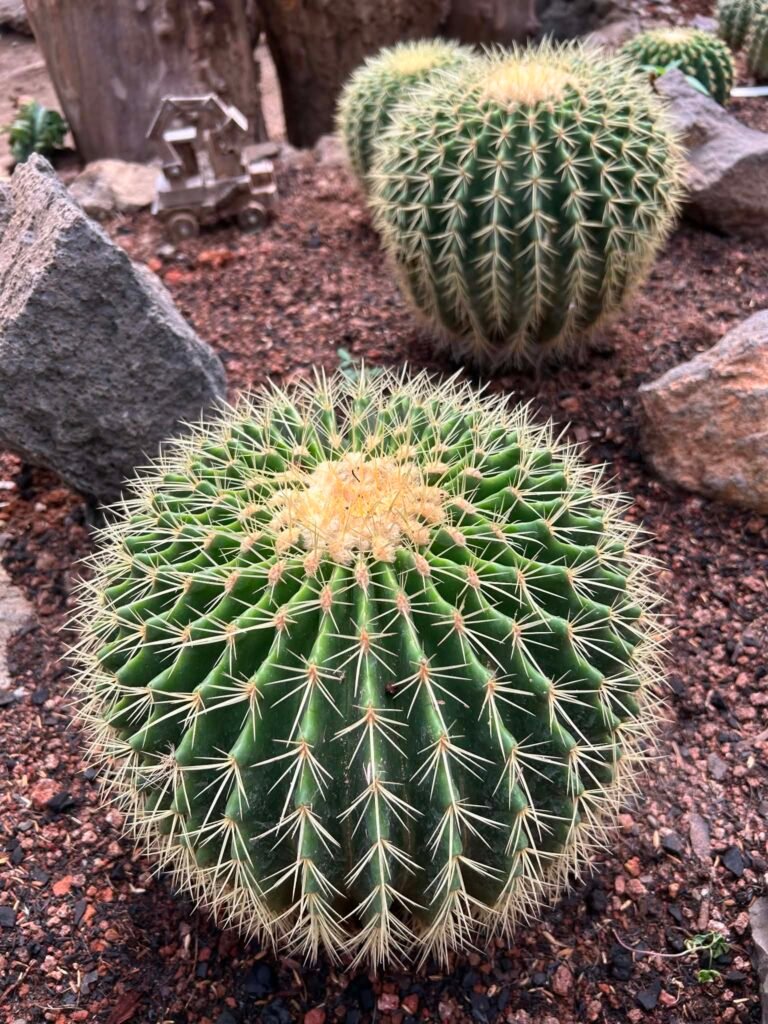
Photography: Green Desert Agritourism Park
Plant Description
Echinocactus grusonii Hildm. is a highly distinctive barrel-shaped cactus native to Mexico. It is widely known as the Golden Barrel Cactus because of its rounded golden-green body and abundant yellowish spines.
The plant develops a strongly ribbed, almost perfectly symmetrical body when young and mature. Numerous regularly arranged areoles occur along the ribs, each producing a cluster of yellow to golden spines. As the plant grows, its body gradually becomes more barrel-shaped.
The Golden Barrel is one of the most widely cultivated ornamental cacti in the world and is especially valued for its geometric symmetry, golden spination, and impressive mature size. RHS describes the plant as developing a barrel-shaped stem up to about 50 cm tall, with deep ribs, yellowish spines, and yellow flowers on mature plants.
Basic Information
Scientific Name: Echinocactus grusonii Hildm.
Current Taxonomic Placement: Kroenleinia grusonii (Hildm.) Lodé
Author Citation: Hildm.
Family: Cactaceae
Genus: Echinocactus
Current genus placement: Kroenleinia
Plant Type: Barrel-shaped solitary cactus
Origin: Mexico
Native Range: Zacatecas to San Luis Potosí, Mexico
Plant Overview
The Golden Barrel Cactus is a slow-growing, highly symmetrical cactus that can remain almost spherical when young before gradually becoming more barrel-shaped with age.
Its deep vertical ribs create a striking geometric structure. The ribs are lined with regularly spaced areoles from which numerous yellowish spines emerge. The dense golden spination gives the entire plant its characteristic appearance.
The growing point at the top of the plant is covered with golden wool, particularly noticeable on actively growing specimens.
Mature plants can eventually produce yellow flowers around the crown, although flowering generally occurs only after the plant has reached considerable maturity.
Botanical Description
Growth Habit
A solitary, globose to barrel-shaped cactus with strongly ribbed green stems.
Young specimens are more spherical, gradually becoming broader and more cylindrical with age.
Mature Size
- Height: approximately 30–50 cm in cultivation
- Width: approximately 30–60 cm or more
- Mature specimens may become substantially larger under favorable conditions
RHS records plants reaching approximately 50 cm in height and up to 1 m in spread under cultivation.
Stem
- Green to dark green
- Globose when young
- Barrel-shaped with age
- Deeply ribbed
- Succulent and water-storing
- Highly symmetrical
Leaves
None.
As in other cacti, the leaves have been evolutionarily modified into spines.
Ribs
- Numerous prominent vertical ribs
- Deeply defined
- Regularly arranged
- Give the plant its characteristic architectural symmetry
Spines
- Yellow to golden-yellow
- Strong and pointed
- Numerous
- Produced from regularly arranged areoles
- Create the characteristic golden appearance
Roots
A shallow but spreading root system adapted to absorb water rapidly following occasional rainfall.
Flowers
- Yellow
- Funnel-shaped to bell-shaped
- Produced around the crown of mature plants
- Approximately up to 6 cm in length
Flowering generally occurs when plants have reached maturity. RHS records yellow flowers up to approximately 6 cm in length.
Fruits
Small fleshy fruits develop after successful pollination.
The fruits may retain woolly or hairy characteristics around the fruiting structures.
Seeds
Produces numerous small seeds within mature fruits.
Seed propagation is the principal method of producing new plants.
Native Habitat
Geographic Distribution
Mexico, particularly the region extending from Zacatecas to San Luis Potosí.
Natural Ecosystem
The species occurs in:
- Desert landscapes
- Dry shrubland
- Rocky terrain
- Semi-arid environments
Climate
Its natural environment is characterized by:
- Strong sunlight
- Warm temperatures
- Seasonal rainfall
- Extended dry periods
- Rapid drainage following rainfall
Soil Type
Well-drained, mineral-rich soils, often associated with rocky terrain.
Growing Conditions
Light
Thrives in bright light to full sun.
Strong light helps maintain compact growth and encourages the development of its characteristic golden spination.
Acclimatize gradually when moving a plant into intense direct sunlight.
Watering
Water thoroughly during active growth and allow the growing medium to dry before watering again.
Reduce watering substantially during cooler or dormant periods.
Avoid prolonged wetness around the roots.
Soil
Use a porous, rapidly draining cactus and succulent mix containing a high proportion of mineral material.
Suitable components include:
- Pumice
- Lava rock
- Coarse sand
- Perlite
- Other porous mineral materials
Temperature
Ideal:
20–30°C during active growth
The plant tolerates cooler conditions when kept dry but should be protected from prolonged cold and wet conditions.
Humidity
Prefers good air circulation and relatively dry conditions.
High humidity combined with poor ventilation can increase the risk of fungal and rot problems.
Fertilization
Feed lightly during active growth using a diluted cactus fertilizer.
Avoid excessive nitrogen.
Potting
Use a container with excellent drainage.
Choose a pot appropriate to the plant’s root system without excessive unused soil that could remain wet for long periods.
Propagation
Usually propagated from seeds.
Seeds can be sown in a porous, well-drained cactus medium under warm conditions.
Seed propagation is particularly important for maintaining genetic diversity.
Growth Rate
Slow.
The Golden Barrel takes many years to develop into a large specimen.
RHS indicates approximately 10–20 years to maturity under its cultivation conditions.
Dormancy
Growth slows during cooler or drier periods.
During dormancy, watering should be greatly reduced or withheld depending on environmental conditions.
Keeping the plant relatively dry during cool periods helps prevent root rot.
Toxicity
⚠ Caution
The plant is not known for poisonous sap, but its numerous strong spines can cause painful punctures and injuries.
Handle carefully when:
- Repotting
- Moving
- Cleaning
- Propagating
Children and pets should be kept away from the sharp spines.
Pests and Diseases
Common problems include:
- Mealybugs
- Scale insects
- Spider mites
- Root rot
- Fungal diseases caused by excessive moisture
- Rot associated with poor drainage
Good drainage, appropriate watering, and adequate air circulation are essential.
Interesting Facts
- The Golden Barrel is one of the world’s most recognizable ornamental cacti.
- Its traditional scientific name is Echinocactus grusonii.
- Kew currently accepts Kroenleinia grusonii as the species name.
- The species was originally described as Echinocactus grusonii in 1886.
- The name Echinocactus derives from Greek echinos, meaning “hedgehog” or “spiny.”
- Its golden-yellow spines give the species its common name.
- Young plants are nearly spherical and become more barrel-shaped with age.
- The plant has deep ribs arranged in a highly symmetrical pattern.
- Mature plants can produce yellow flowers around the crown.
- The species is native to Mexico.
- The plant is considered endangered in its natural range under the IUCN assessment associated with the traditional name Echinocactus grusonii.
Landscape and Collection Value
Ideal for:
- Cactus collections
- Botanical gardens
- Xeriscape gardens
- Rock gardens
- Architectural landscapes
- Container cultivation
- Greenhouse collections
The Golden Barrel is especially valuable as a specimen plant because of its remarkable symmetry and strong golden coloration.
Its rounded form also provides an attractive contrast when planted among rocks, gravel, and other sculptural succulents.
At Green Desert Agritourism Park, the species is particularly appropriate for educational display because its distinctive appearance makes it immediately recognizable to visitors.
Conservation Status
The current Kew treatment recognizes Kroenleinia grusonii as the accepted name and gives its native range as Mexico from Zacatecas to San Luis Potosí.
Under the traditional name Echinocactus grusonii, the IUCN assessment cited by Kew lists the species as Endangered (EN).
This makes cultivated specimens particularly meaningful. Living collections such as the Green Desert Botanical Library can contribute to ex-situ conservation, public education, and appreciation of threatened Mexican cactus flora.
Life’s Whisper
“Stand firmly where you are planted. Like the Golden Barrel, strength is built slowly, beauty is shaped by time, and even the harshest desert can produce something extraordinary.”
Green Desert Botanical Library Notes
This specimen forms part of the living collection of Green Desert Agritourism Park and is documented within the Echinocactus Plant Directory.
Its rounded barrel-shaped body, numerous deep ribs, regularly arranged areoles, and dense golden-yellow spination strongly support its identification as the plant traditionally known as Echinocactus grusonii Hildm.
The Green Desert Botanical Library uses Echinocactus grusonii as the primary collection name because it remains the familiar horticultural name associated with the Golden Barrel Cactus.
For botanical accuracy, the Library also records the current Kew placement, Kroenleinia grusonii (Hildm.) Lodé. Kew treats Echinocactus grusonii as a synonym of Kroenleinia grusonii.
This approach allows the Library to preserve the name familiar to cactus collectors while also documenting modern taxonomic treatment.
Navigation
⬅ Previous Plant: Echinocactus — Previous Collection Specimen
🏠 Home: Botanical Library – Echinocactus Collection
➡ Next Plant: Echinocactus — Next Collection Specimen
References
For the complete list of botanical references, scientific literature, and online resources used in preparing the Green Desert Botanical Library, please visit the References page available from the Main Menu.