
Plant ID
GD-CAC-002–0021
Common Name(s)
- Crown Cactus
- Canigueralii Rebutia
- Canigueralii Crown Cactus
Plant Photograph
📷 Figure 1. Rebutia canigueralii Cárdenas
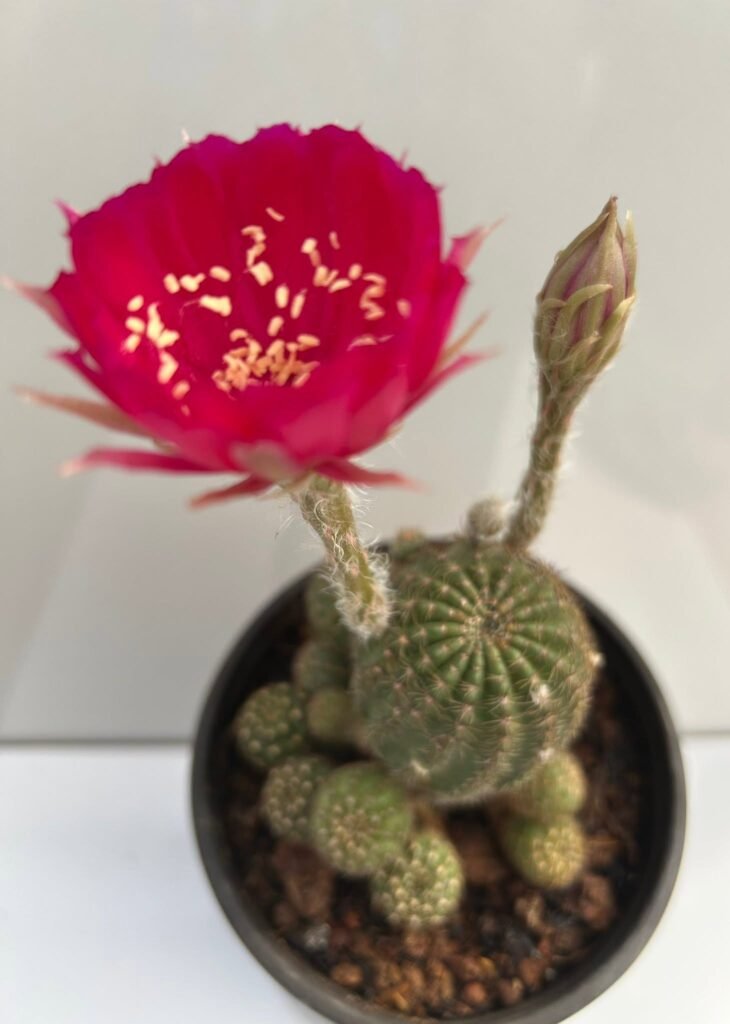
Photography: Green Desert Botanical Library
Picture Description
A close-up view of Rebutia canigueralii in flower, showing a compact cluster of small green globose stems covered with fine, pale, bristly spines. A large vivid pink-red flower rises above the plant, displaying numerous overlapping petals and a contrasting yellowish center. An unopened flower bud is also visible, illustrating the plant’s characteristic flowering habit. Photographed at Green Desert Agritourism Park, this specimen demonstrates the compact clustering habit and spectacular floral display that make this South American cactus highly valued by collectors.
Plant Description
Rebutia canigueralii Cárdenas is a small, clustering cactus characterized by its globose green stems, dense colony-forming habit, and fine bristly white spines. Mature plants can form compact colonies of numerous small heads.
The species is particularly notable for its attractive funnel-shaped flowers. Flower colors may include orange, pink, and red, with individual flowers sometimes displaying contrasting coloration toward the throat. The Green Desert specimen photographed here produces a vivid pink-red flower.
The species was described by Bolivian botanist Martín Cárdenas in 1964 as Rebutia canigueralii. It was subsequently transferred to Sulcorebutia and later to Weingartia. Kew currently accepts Weingartia canigueralii (Cárdenas) F.H.Brandt, while Rebutia canigueralii remains an important historical and horticultural name.
Basic Information
Scientific Name: Rebutia canigueralii Cárdenas
Current Accepted Name: Weingartia canigueralii (Cárdenas) F.H.Brandt
Author Citation: Cárdenas
Family: Cactaceae
Genus: Rebutia
Current Taxonomic Placement: Weingartia
Plant Type: Small clustering cactus
Origin: Bolivia
Historical Synonym: Sulcorebutia canigueralii (Cárdenas) Buining & Donald
Plant Overview
Rebutia canigueralii is a small, low-growing cactus that develops a dense colony of globose green stems. Its numerous offsets gradually form a compact cluster, giving the mature plant a rounded, cushion-like appearance.
The stems are covered with fine, bristly pale spines that curve outward from the areoles. These spines give the plant a soft, textured appearance while protecting the succulent body.
The flowers provide the principal ornamental attraction. Bright funnel-shaped blooms may appear in shades of orange, pink, or red. The Green Desert specimen displays a particularly vivid pink-red flower, creating a striking contrast with the green, finely spined stems.
Botanical Description
Growth Habit
A small, low-growing, densely clustering cactus.
Individual globose stems produce offsets around the base, eventually forming a compact colony.
Mature Size
- Individual stems: approximately up to 5 cm tall
- Mature cultivated plant: generally remains compact
- Dense clusters may reach approximately 10 cm in overall height
RHS records the species as forming dense colonies of globose stems to approximately 5 cm tall, with cultivated plants reaching up to about 10 cm in height.
Stem
- Globose
- Green to occasionally purple-flushed
- Succulent
- Small and compact
- Strongly clustered with age
Leaves
None.
As with other cacti, the leaves are evolutionarily modified into spines.
Spines
- Fine and bristly
- White to pale in color
- Recurved or spreading
- Arising from the areoles
- Closely distributed across the stems
The bristly white spines are one of the useful visual characteristics of the species.
Roots
A succulent cactus root system adapted to well-drained, seasonally dry soils.
The roots are vulnerable to prolonged waterlogging.
Flowers
- Funnel-shaped
- Large relative to the small stem
- Produced from the sides of the plant
- Bright orange, pink, or red
- May display a contrasting throat
- Can occur abundantly on mature clusters
The Green Desert specimen displays a vivid pink-red flower with a yellowish center.
RHS records orange, pink and red flowers for Rebutia canigueralii.
Fruits
Small fruits develop after successful pollination.
Seeds
Produces small seeds contained within mature fruits.
Seed propagation can be used to produce new plants and maintain genetic diversity.
Native Habitat
Geographic Distribution
Bolivia
Kew currently gives Bolivia as the native range of Weingartia canigueralii. Historical botanical sources associate the species with the Bolivian highlands, including the Chuquisaca region.
Natural Ecosystem
Typical environments include:
- Dry shrubland
- Semi-arid mountain habitats
- Rocky slopes
- Dry inter-Andean landscapes
Kew describes the species as growing primarily in desert or dry shrubland biomes.
Climate
The natural environment is characterized by:
- Strong sunlight
- Seasonal rainfall
- Pronounced dry periods
- Relatively cool mountain conditions
- Significant day-to-night temperature variation
Soil Type
Well-drained rocky, sandy, and mineral-rich soils.
The species is adapted to conditions where excess water drains rapidly away from the roots.
Growing Conditions
Light
Thrives in bright light to full sun.
Strong light supports compact growth, healthy spination, and flowering.
In hot tropical climates, gradual acclimatization and protection from extreme midday heat may be beneficial.
Watering
Water thoroughly during active growth and allow the growing medium to dry before watering again.
Avoid keeping the soil continuously wet.
Reduce watering during cooler or dormant periods.
Soil
Use a very porous and rapidly draining cactus mixture with a high proportion of mineral material.
Suitable components include:
- Pumice
- Lava rock
- Coarse sand or grit
- Perlite
- Other porous mineral materials
Temperature
Ideal:
15–30°C
The plant benefits from cooler and drier conditions during its resting period.
Protect from prolonged cold combined with wet soil.
Humidity
Prefers good ventilation and relatively dry conditions.
In tropical environments, excellent air movement is particularly important.
Fertilization
Feed lightly during active growth with a diluted cactus and succulent fertilizer.
Avoid excessive nitrogen.
Potting
Use a container with excellent drainage.
A relatively small pot is suitable because the plant remains compact while producing offsets around the base.
Propagation
Usually propagated from:
- Seeds
- Offsets
Offsets can be separated carefully from mature clusters and allowed to dry before planting in a porous growing medium.
Seeds may be sown under suitable warm conditions and are useful for maintaining genetic diversity.
Growth Rate
Slow to moderate.
Individual stems remain small, but the plant can gradually form a substantial colony through offset production.
Dormancy
Growth slows during cooler or drier periods.
A relatively dry resting period is beneficial and may encourage flowering during the following growing season.
Toxicity
⚠ Generally considered non-toxic
Rebutia canigueralii does not produce the irritating milky latex characteristic of Euphorbia.
However, the plant’s spines can cause:
- Skin punctures
- Minor wounds
- Irritation
Handle carefully when repotting or separating offsets.
Pests and Diseases
Common problems include:
- Mealybugs
- Scale insects
- Spider mites
- Root rot caused by overwatering
- Stem rot in prolonged wet conditions
- Fungal problems in poorly ventilated environments
Good drainage and air circulation are essential.
Interesting Facts
- Rebutia canigueralii was described by Martín Cárdenas in 1964.
- The species has been classified under Rebutia, Sulcorebutia, and Weingartia.
- Kew currently accepts Weingartia canigueralii as the scientific name.
- Rebutia canigueralii remains a widely recognized horticultural name.
- The plant forms dense colonies of small globose stems.
- Its spines are characteristically fine, white and bristly.
- Flowers may be orange, pink, or red.
- The species is native to Bolivia.
- Several historical names have been associated with the species, reflecting its complex taxonomic history.
- The species has been recorded as Least Concern (LC) under an IUCN assessment associated with the historical name Rebutia canigueralii.
Landscape and Collection Value
Ideal for:
- Cactus collections
- Botanical gardens
- Rock gardens
- Xeriscape displays
- Container cultivation
- Greenhouses
- Specialty succulent collections
Its compact size allows it to fit easily into small collections, while its dense clustering habit creates an attractive specimen as the plant matures.
The spectacular pink-red flowers of the Green Desert specimen provide exceptional ornamental value and demonstrate the remarkable flower-to-plant-size ratio characteristic of many Rebutia-type cacti.
Conservation Status
The species is currently accepted by Kew as Weingartia canigueralii. Under the historical name Rebutia canigueralii, an IUCN assessment records the species as Least Concern (LC). Kew also reports a low-confidence prediction of the species being not threatened.
Cultivated specimens such as the Green Desert plant contribute to ex-situ conservation by maintaining living representatives of Bolivia’s distinctive cactus flora.
Life’s Whisper
“Even in a small body, life can hold an extraordinary burst of color. Grow patiently, gather strength quietly, and when your moment comes, bloom boldly.”
Green Desert Botanical Library Notes
This specimen forms part of the living collection of Green Desert Agritourism Park.
Based on its small globose stems, dense clustering habit, fine pale bristly spines, and large pink-red flower, the specimen is documented as Rebutia canigueralii Cárdenas.
Modern taxonomic treatment places this species under Weingartia canigueralii (Cárdenas) F.H.Brandt, while Sulcorebutia canigueralii is another historical combination.
The Green Desert Botanical Library retains Rebutia canigueralii as the primary collection name because it is a familiar horticultural name and is consistent with the established organization of the Green Desert Rebutia Plant Directory.
The exact cultivar or subspecific identity of this specimen has not been assigned from the photograph alone.
Navigation
⬅ Previous Plant: Rebutia minuscula
🏠 Home: Botanical Library – Rebutia Collection
➡ Next Plant: Rebutia — Next Collection Specimen
References
For the complete list of botanical references, scientific literature, and online resources used in preparing the Green Desert Botanical Library, please visit the References page available from the Main Menu.