
Plant ID
GD-CAC-002-0020
Common Name(s)
- Pink Crown Cactus
- Pink-Flowered Rebutia
- Crown Cactus
- Pink-Flowered Form of Rebutia minuscula
Plant Photograph
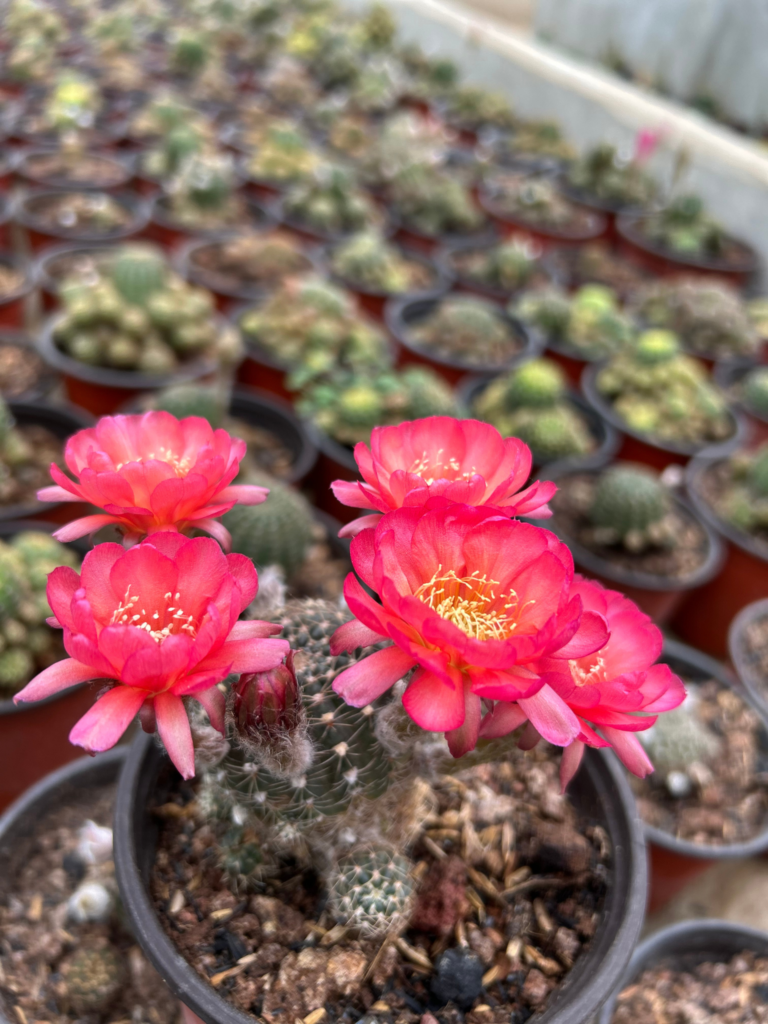
📷 Figure 1. Rebutia minuscula K.Schum. — Pink-Flowered Form
Photography: Green Deset Botanical Library
Plant Description
Rebutia minuscula K.Schum. is a small, clustering cactus belonging to the family Cactaceae. It is characterized by its compact globose to slightly flattened green stems, numerous small tubercles, and fine, closely arranged spines.
The species is especially admired for its abundant flowers, which emerge from the lower portions of the stems rather than only from the growing apex. Flower colors vary within the species and its historically recognized forms, ranging from red and orange to pink and violet-pink.
The specimen documented here displays exceptionally vivid pink flowers. This appearance corresponds closely with the plant historically known as Rebutia violaciflora, a name that Kew currently treats as a synonym of Rebutia minuscula var. minuscula.
Basic Information
Scientific Name: Rebutia minuscula K.Schum.
Author Citation: K.Schum.
Family: Cactaceae
Genus: Rebutia
Plant Type: Small clustering cactus
Origin: Northwestern Argentina
Historical Name: Rebutia violaciflora Backeb.
Current Taxonomic Placement: Rebutia minuscula var. minuscula
Plant Overview
Rebutia minuscula is one of the characteristic small flowering cacti of the Rebutia group. Its compact stems remain relatively small while gradually producing offsets that can develop into attractive clusters.
The plant’s body is finely textured by numerous tubercles and delicate spines. Although attractive throughout the year, its greatest ornamental feature is its flowering display.
The flowers arise around the lower portions of the stems and can appear in abundance. In the pink-flowered form represented by the Green Desert specimen, the brilliant pink blooms create a spectacular contrast against the green, finely spined body.
The species is also botanically significant because many names formerly treated as separate Rebutia species or forms are now included within the broader concept of Rebutia minuscula. Kew currently recognizes Rebutia minuscula as an accepted species.
Botanical Description
Growth Habit
A small, globose to slightly flattened cactus that may begin as a solitary plant and gradually produce numerous offsets.
Mature plants can form compact clusters or cushions.
Mature Size
- Individual stems: approximately 2–5 cm in diameter
- Overall mature clusters: commonly 5–10 cm or more across in cultivation
- Individual stems remain relatively small
RHS describes Rebutia plants as solitary or clustering cacti with globose or shortly cylindrical stems.
Stem
- Green to dark green
- Globose to slightly flattened
- Apex often somewhat depressed
- Covered with numerous small tubercles
- Compact and succulent
- Produces offsets with age
Leaves
None.
As in other cacti, the leaves have been evolutionarily modified into spines.
Spines
- Fine and bristle-like
- Usually pale white to whitish
- Closely arranged around the areoles
- May become somewhat yellowish under strong sunlight
- Relatively delicate compared with the spines of many larger cacti
The fine spination creates a soft, textured appearance over the green body.
Roots
A fibrous root system adapted to rapidly draining soils.
The plant is sensitive to prolonged waterlogging.
Flowers
- Funnel-shaped
- Large relative to the small plant body
- Produced from the lower portions of the stem
- Often several flowers open simultaneously
- Pink to bright pink in the specimen documented here
- Yellow stamens prominently visible at the center
The historically named Rebutia violaciflora is particularly associated with bright pink flowers borne in a ring around the base of the stem. RHS gives this characteristic in its description, while Kew currently treats the name as a synonym of R. minuscula var. minuscula.
Fruits
Small globose fruits develop following successful pollination.
Seeds
Produces small seeds within mature fruits.
Seed propagation is possible and can produce considerable variation among seedlings.
Native Habitat
Geographic Distribution
Northwestern Argentina
Kew currently gives northwestern Argentina as the native range of Rebutia minuscula.
Natural Ecosystem
Typical environments include:
- Dry mountain valleys
- Rocky slopes
- Semi-arid landscapes
- Highland shrublands
- Seasonally dry habitats
Climate
Warm to moderately cool mountain conditions with:
- Strong sunlight
- Seasonal rainfall
- Distinct dry periods
- Cooler nights
- Significant day-to-night temperature differences
Soil Type
Naturally occurring plants are associated with rocky, sandy, mineral-rich and rapidly draining soils.
Growing Conditions
Light
Thrives in bright light to full sun.
Good light encourages compact growth, healthy spination and abundant flowering.
In hot tropical climates, gradual acclimatization and protection from extreme midday heat may be beneficial.
Watering
Water thoroughly during active growth and allow the growing medium to dry before watering again.
Avoid continuously wet soil.
Reduce watering substantially during cool or dormant periods.
Soil
Use a porous, rapidly draining cactus and succulent mixture with a substantial mineral component.
Suitable materials include:
- Pumice
- Lava rock
- Coarse sand
- Perlite
- Other porous mineral materials
Temperature
Ideal:
15–30°C
The plant benefits from cooler and drier conditions during its resting period.
Protect from prolonged exposure to cold, wet conditions.
Humidity
Prefers good air circulation and relatively dry conditions.
In tropical climates, excellent ventilation is particularly important.
Fertilization
Feed lightly during active growth with a diluted cactus or succulent fertilizer.
Avoid excessive nitrogen.
Potting
Use a container with excellent drainage.
A relatively small pot is suitable because the plant remains compact and develops a shallow cluster.
Propagation
Usually propagated from:
- Seeds
- Offsets
Offsets can be separated carefully from established clusters and allowed to dry before planting in a porous medium.
Seed propagation is useful for maintaining genetic diversity.
Growth Rate
Slow to moderate.
The plant remains relatively small but can gradually develop a substantial cluster through offset production.
Dormancy
Growth slows during cool or dry periods.
A relatively dry resting period can help maintain healthy roots and encourage flowering during the subsequent growing season.
Toxicity
⚠ Generally considered non-toxic
Rebutia minuscula does not produce the irritating milky latex associated with Euphorbia.
However, its spines can cause:
- Skin punctures
- Minor wounds
- Irritation
Handle carefully when repotting or separating offsets.
Pests and Diseases
Common problems include:
- Mealybugs
- Scale insects
- Spider mites
- Root rot caused by overwatering
- Fungal problems under prolonged wet conditions
- Stem rot in poorly ventilated environments
Good drainage and air circulation are essential for maintaining healthy plants.
Interesting Facts
- Rebutia minuscula was described by Karl Moritz Schumann in 1895.
- It is the type species of the genus Rebutia.
- Its native range is in northwestern Argentina.
- The species has historically been divided into numerous forms, varieties and related names.
- Rebutia violaciflora is currently treated by Kew as a synonym of Rebutia minuscula var. minuscula.
- The flowers emerge around the lower portion of the stem rather than only from the apex.
- A small plant can produce numerous flowers simultaneously.
- The pink-flowered forms are particularly popular among cactus collectors.
- Mature plants can form attractive clusters through offset production.
- The species demonstrates how cactus taxonomy can change as botanical research advances.
Landscape and Collection Value
Ideal for:
- Cactus collections
- Botanical gardens
- Rock gardens
- Xeriscape displays
- Container cultivation
- Greenhouses
- Specialty succulent collections
Its compact size makes it particularly suitable for small containers, while its spectacular flowering habit gives it exceptional ornamental value.
The vivid pink flowers of this Green Desert specimen make it an especially attractive representative of the Rebutia collection.
Conservation Status
Rebutia minuscula is currently recognized as an accepted species by Plants of the World Online, with a native range in northwestern Argentina.
The conservation status of the species should be interpreted using the latest authoritative assessment. Cultivated specimens contribute to ex-situ conservation and help preserve living representatives of South America’s distinctive cactus flora.
Life’s Whisper
“A small heart can hold an extraordinary capacity to bloom. Like the Rebutia, we may grow quietly and modestly, yet when our season comes, our hidden beauty can fill the world with color.”
Green Desert Botanical Library Notes
This specimen forms part of the living collection of Green Desert Agritourism Park.
Based on its compact clustered growth, fine pale spination, and large vivid pink flowers emerging around the lower portions of the stems, the specimen is documented as Rebutia minuscula K.Schum., pink-flowered form.
The historical name Rebutia violaciflora Backeb. is recorded as an important synonym because plants with this appearance have traditionally been identified under that name. Current Kew treatment places R. violaciflora within Rebutia minuscula var. minuscula.
The Green Desert Botanical Library uses the current species name while preserving the historical identification to make the collection scientifically informative and useful to cactus enthusiasts.
Navigation
⬅ Previous Plant: Rebutia arenacea
🏠 Home: Botanical Library – Rebutia Collection
➡ Next Plant: Rebutia [Next Collection Specimen]
References
For the complete list of botanical references, scientific literature, and online resources used in preparing the Green Desert Botanical Library, please visit the References page available from the Main Menu.