
Plant ID
GD-EUP-003-0017
Common Name(s)
- Pincushion Euphorbia
- Red-Spined Euphorbia
- Red Thorn Euphorbia
- Hedgehog Euphorbia
- Spiny Milk Spurge
Plant Photograph
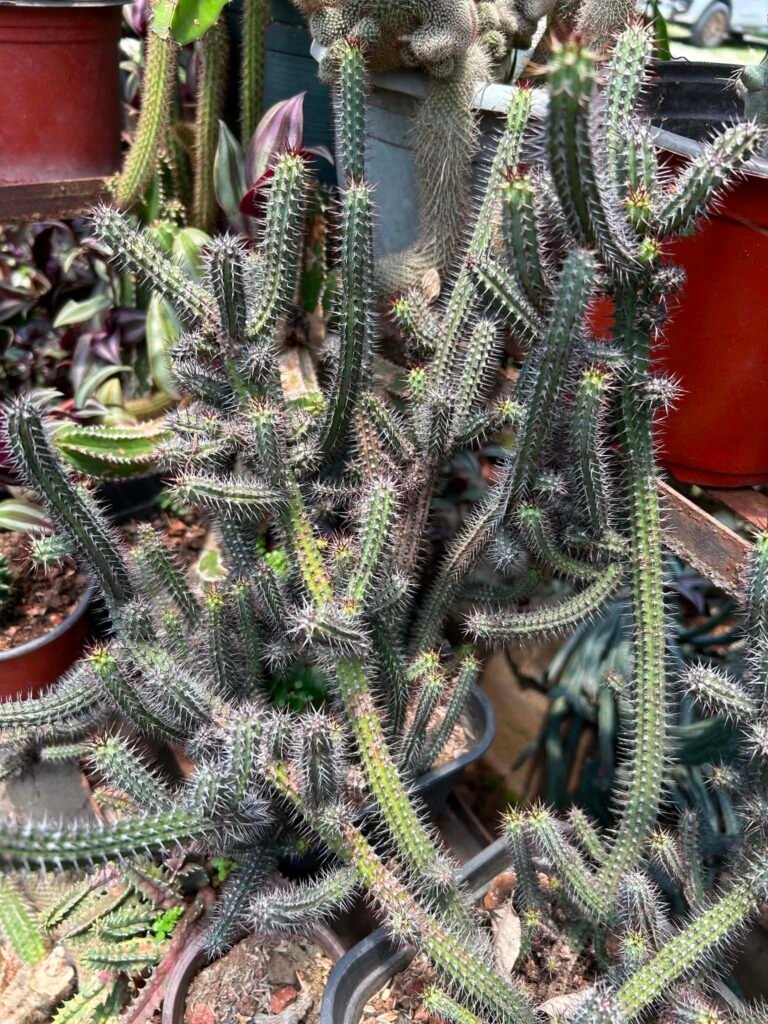
📷 Figure 1. Euphorbia enopla
Plant Photography: Green Desert Botanical Library
Plant Description
Euphorbia enopla is a compact, clump-forming succulent native to South Africa and admired for its striking display of long, colorful spines. Unlike many columnar Euphorbia species with winged stems, this species develops slender cylindrical stems covered with regularly arranged tubercles, each bearing a pair of spines. Young spines are often bright red, gradually fading to gray or whitish as they age, giving the plant exceptional ornamental appeal.
Its compact habit and dramatic spine coloration make Euphorbia enopla a favorite among collectors of miniature succulent spurges. Although often mistaken for a cactus, it belongs to the family Euphorbiaceae and produces the characteristic white milky latex of the genus.
Basic Information
Scientific Name: Euphorbia enopla
Author Citation: Boiss.
Family: Euphorbiaceae
Genus: Euphorbia
Plant Type: Succulent shrub
Origin: Eastern Cape, South Africa
Plant Overview
This species forms dense clusters of upright cylindrical stems arising from the base. The colorful spines provide year-round visual interest, while the compact growth habit makes it ideal for containers and small succulent displays. Mature specimens gradually develop attractive clumps that become increasingly ornamental with age.
Botanical Description
Growth Habit
A clump-forming succulent with erect cylindrical stems.
Mature Size
- Height: 20–60 cm
- Spread: 20–50 cm
Stem
- Cylindrical
- Green to gray-green
- Covered with distinct tubercles
- White milky latex when cut
Leaves
Tiny leaves appear briefly on new growth before dropping naturally.
Spines
- Long paired spines
- Bright red when young
- Aging to gray or white
- Produced from each tubercle
Roots
Fibrous root system adapted to rocky, well-drained soils.
Flowers
Small yellow-green cyathia near the stem tips during the growing season.
Native Habitat
Geographic Distribution
Native to:
- Eastern Cape Province, South Africa
Natural Ecosystem
- Rocky hillsides
- Dry scrubland
- Semi-arid succulent habitats
Climate
Warm, dry climate with seasonal rainfall.
Soil Type
Rocky, sandy, fast-draining soils.
Growing Conditions
Light
Bright light to full sun.
Watering
Allow the soil to dry completely between waterings.
Soil
Fast-draining mineral-rich cactus or succulent mix.
Temperature
Ideal:
18–32°C
Protect from frost.
Humidity
Prefers low humidity and good air circulation.
Fertilization
Apply a diluted succulent fertilizer once or twice during the growing season.
Potting
Use shallow containers with excellent drainage.
Propagation
Usually propagated by offsets or stem cuttings.
Allow cuttings to callus completely before planting.
⚠ Wear gloves because the white milky latex may irritate the skin.
Growth Rate
Slow to moderate.
Dormancy
Growth slows during cool winter months.
Toxicity
⚠ Caution
Like all members of the genus Euphorbia, this plant produces a white milky latex that:
- Irritates the skin.
- Can cause severe eye irritation.
- Is toxic if ingested.
Keep away from children and pets.
Pests and Diseases
Common problems include:
- Mealybugs
- Scale insects
- Spider mites
- Root rot caused by excessive watering
Interesting Facts
- One of the few Euphorbia species famous for its brilliant red spines.
- Often mistaken for a cactus because of its cylindrical stems and dense armament.
- Forms attractive clumps with age.
- Native to South Africa’s rich succulent flora.
- A prized species among collectors of rare succulent spurges.
Landscape and Collection Value
Recommended for:
- Collector’s succulent collections
- Botanical gardens
- Rock gardens
- Container displays
- Educational displays comparing cacti and Euphorbia
Conservation Status
Although native populations occur in South Africa, cultivated plants are widely propagated by specialist growers, reducing pressure on wild populations.
Life’s Whisper
“Strength is not measured by softness or hardness alone, but by the courage to protect what is precious while continuing to grow.”
Green Desert Botanical Library Notes
This specimen forms part of the living collection of Green Desert Agritourism Park. Its brilliant red spines and compact clustering habit make it one of the most visually striking members of the Euphorbia collection. It also serves as an excellent educational example of how spurges can closely resemble cacti while belonging to an entirely different plant family.
Navigation
⬅ Previous Plant: Euphorbia lactea f. monstrosa
🏠 Home: Botanical Library – Euphorbia Collection
➡ Next Plant: Euphorbia mammillaris
References
For the complete list of botanical references, scientific literature, and online resources used in preparing the Green Desert Botanical Library, please visit the References page available from the Main Menu.