
Plant ID
GD-EUP-003-0010
Common Name(s)
- Variegated Dragon Bone Euphorbia
- Variegated Dragon Bone Cactus*
- Variegated Candelabra Spurge
- Variegated Dragon Bones Plant
*Although commonly called a “cactus,” this plant belongs to the spurge family (Euphorbiaceae) and is not a true cactus.
Plant Photograph
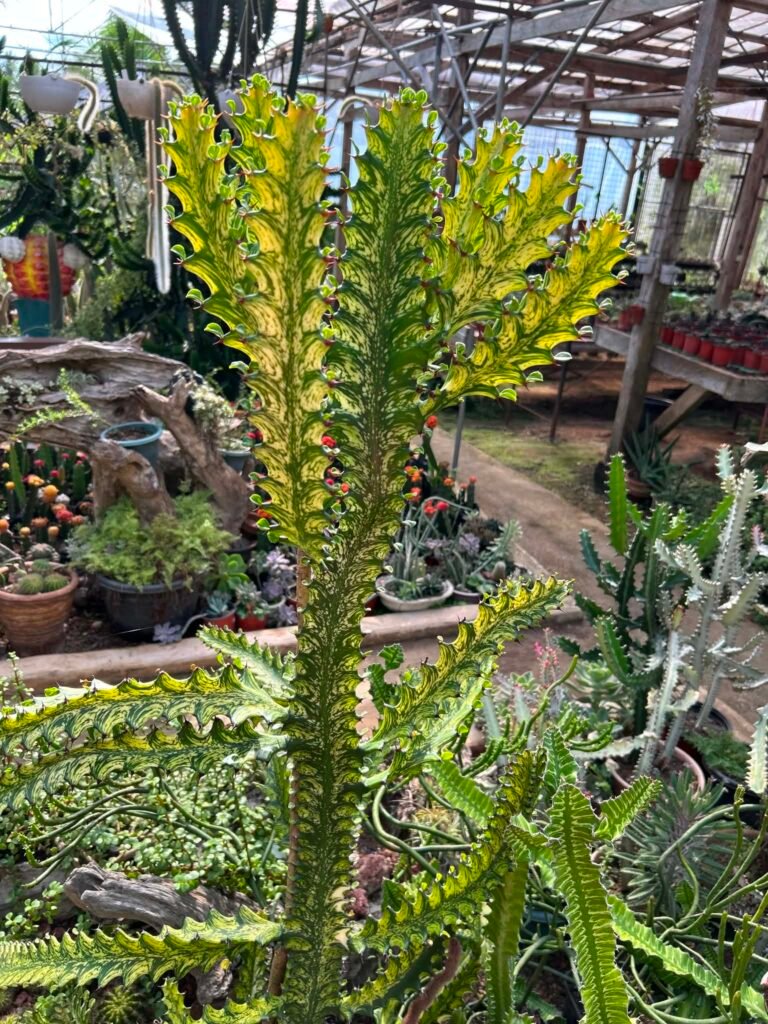
📷 Figure 1. Euphorbia lactea ‘Variegata’
Plant Photography: Green Desert Botanical Library
Picture Description
A magnificent specimen of Euphorbia lactea ‘Variegata’, displaying broad winged stems richly marbled with emerald green and creamy yellow variegation. The wavy stem margins are lined with paired reddish spines and tiny leaves emerging from active growing points. Illuminated by sunlight, the translucent variegated tissues create a brilliant stained-glass effect that highlights one of the most ornamental forms of the Dragon Bone Euphorbia. Photographed at Green Desert Agritourism Park, this specimen demonstrates the remarkable beauty of naturally variegated succulent spurges.
Plant Description
Euphorbia lactea ‘Variegata’ is one of the most spectacular ornamental forms of the Dragon Bone Euphorbia. Its broad, upright stems are beautifully patterned with irregular streaks and marbling of deep green and creamy yellow, giving each plant a unique appearance. The vivid variegation becomes especially striking when backlit by sunlight, making the plant appear almost luminous.
Like the typical green form, this plant possesses four-angled winged stems with undulating margins armed with paired spines. The cream-colored areas contain little or no chlorophyll, so the green portions of the stem perform most of the photosynthesis. Because of this reduced chlorophyll content, variegated plants generally grow more slowly than the standard species. Its bold architectural form and brilliant coloration make it one of the most prized specimens in succulent collections worldwide.
Basic Information
Scientific Name: Euphorbia lactea ‘Variegata’
Author Citation: Based on Euphorbia lactea Haw.
Family: Euphorbiaceae
Genus: Euphorbia
Plant Type: Variegated succulent shrub
Origin: A cultivated variegated form of Euphorbia lactea, a species native to India and Sri Lanka.
Plant Overview
The variegated Dragon Bone Euphorbia combines the dramatic architecture of Euphorbia lactea with stable ornamental variegation. Thick winged stems branch into an upright candelabra-like framework, while each stem displays a unique pattern of cream and green marbling. Young growth often emerges bright yellow-green before maturing into more complex patterns.
This cultivar is highly prized by collectors because no two specimens display identical variegation. Its striking colors and sculptural growth make it an outstanding focal point in succulent gardens and container displays.
Botanical Description
Growth Habit
An upright, branching succulent shrub with candelabra-like growth.
Mature Size
- Height: 2–5 meters in the landscape
- Height in containers: 60–200 cm
Stem
- Four-angled winged stems
- Deep green with creamy yellow variegation
- Wavy margins
- Thick, water-storing succulent tissue
- White milky latex when cut
Leaves
Tiny leaves appear briefly on actively growing stems before naturally dropping.
Spines
- Short paired reddish-brown spines
- Located along the wing margins
Roots
Fibrous root system adapted to well-drained soils.
Flowers
Tiny yellow-green cyathia produced near actively growing stem tips.
Fruits
Small three-lobed capsules.
Seeds
Rarely produced in cultivated ornamental plants.
Native Habitat
Geographic Distribution
Derived from Euphorbia lactea, native to:
- India
- Sri Lanka
Natural Ecosystem
- Dry tropical forests
- Rocky hillsides
- Open scrublands
Climate
Warm tropical to subtropical climates with alternating wet and dry seasons.
Soil Type
Well-drained sandy or rocky soils.
Growing Conditions
Light
Bright light to full sun. Morning sun enhances variegation while protection from intense afternoon heat helps prevent sun scorch.
Watering
Allow the soil to dry completely between waterings.
Soil
A fast-draining cactus or succulent mix rich in mineral components.
Temperature
Ideal:
20–35°C
Protect from temperatures below 10°C.
Humidity
Prefers low humidity and excellent air circulation.
Fertilization
Apply a diluted balanced fertilizer once or twice during the growing season.
Potting
Use sturdy containers with excellent drainage.
Propagation
Usually propagated from stem cuttings.
Allow cut surfaces to callus completely before planting.
⚠ Wear gloves because the white milky latex can irritate the skin.
Growth Rate
Slow to moderate.
Dormancy
Growth slows during cool weather.
Toxicity
⚠ Caution
The white milky latex may:
- Irritate the skin.
- Cause severe eye irritation.
- Be toxic if ingested.
Handle with care and keep away from children and pets.
Pests and Diseases
Common problems include:
- Mealybugs
- Scale insects
- Spider mites
- Root rot from overwatering
- Fungal stem diseases under poor drainage
Interesting Facts
- One of the most striking variegated forms of Euphorbia lactea.
- Every stem displays a unique variegation pattern.
- The cream-colored tissue contains little chlorophyll.
- Often used as a specimen plant in botanical gardens.
- Commonly mistaken for a cactus despite belonging to the spurge family.
- Frequently used as grafting stock for crested forms.
Landscape and Collection Value
Recommended for:
- Premium succulent collections
- Botanical gardens
- Specimen container displays
- Xeriscape landscapes
- Educational displays on plant variegation
Its luminous variegation makes it one of the finest ornamental Euphorbia cultivars.
Conservation Status
This is a cultivated ornamental cultivar maintained through horticultural propagation rather than a naturally occurring wild population.
Life’s Whisper
“True beauty is found in our differences. Like the variegated Dragon Bone Euphorbia, the unique patterns woven into our lives make each of us wonderfully one of a kind.”
Green Desert Botanical Library Notes
This specimen is part of the living collection of Green Desert Agritourism Park. Its exceptional cream-and-green variegation, combined with vigorous upright growth, makes it one of the signature ornamental Euphorbia in the collection. It beautifully demonstrates how natural variation can transform a hardy desert plant into a living masterpiece.
Navigation
⬅ Previous Plant: Euphorbia lactea (Dragon Bone Euphorbia)
🏠 Home: Botanical Library – Euphorbia Collection
➡ Next Plant: Euphorbia lactea f. cristata (Green Form)
References
For the complete list of botanical references, scientific literature, and online resources used in preparing the Green Desert Botanical Library, please visit the References page available from the Main Menu.