
Plant ID
GD-EUP-003-0008
Common Name(s)
- Dragon Bones Tree
- Dragon Bones Euphorbia
- Dragon Bone Spurge
- Slender Spurge
Plant Photograph
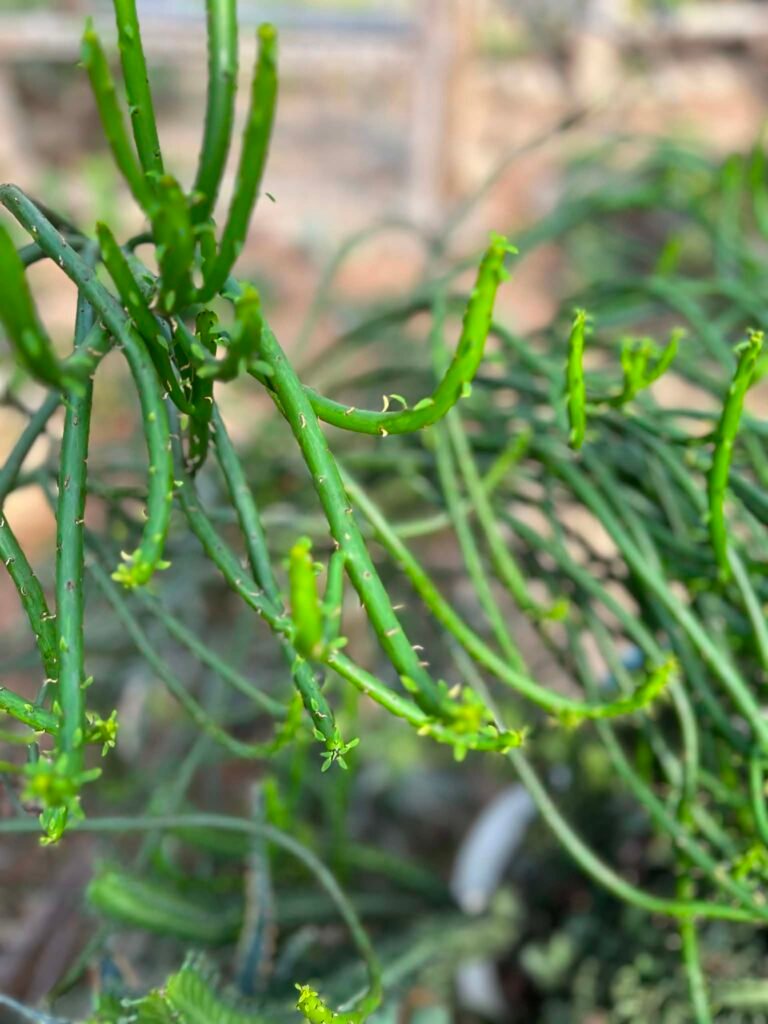
📷 Figure 1. Euphorbia cf. leucodendron
Photogrpahy: Green Desert Botanical Library
Picture Description
A close-up view of Euphorbia cf. leucodendron, commonly known as the Dragon Bones Tree, showing its slender, cylindrical green branches and delicate new growth emerging from the stem tips. Tiny, short-lived leaves are visible along the actively growing shoots, a characteristic feature of this drought-adapted succulent. The smooth, leafless stems perform most of the plant’s photosynthesis while storing water for extended dry periods. Photographed at Green Desert Agritourism Park, this specimen highlights the graceful branching habit and elegant simplicity that distinguish this remarkable African spurge.
Plant Description
Euphorbia cf. leucodendron, commonly referred to as the Dragon Bones Tree, is a graceful succulent shrub admired for its intricate network of slender, cylindrical branches that create a light, airy canopy. Although often mistaken for the closely related Pencil Tree (Euphorbia tirucalli), this species typically exhibits a more delicate branching pattern and a bluish-green coloration that gives the plant a distinctive appearance.
Native to the dry regions of Madagascar, it has evolved remarkable adaptations for surviving prolonged drought. The tiny leaves appear only briefly on new growth before falling, leaving the smooth green stems to carry out photosynthesis. Its sculptural form and elegant branching habit make it an attractive specimen for succulent collections, xeriscape gardens, and botanical displays, where it is appreciated both for its architectural beauty and its resilience.
Basic Information
Scientific Name: Euphorbia cf. leucodendron
Author Citation: Pending confirmation
Family: Euphorbiaceae
Genus: Euphorbia
Plant Type: Succulent shrub
Origin: Presumed Madagascar
Plant Overview
The Dragon Bones Tree is one of several slender-stemmed succulent spurges that have adapted to arid climates by reducing their leaves and storing water within their stems. As the plant matures, numerous cylindrical branches develop from the main framework, creating an elegant, open structure that resembles a network of living green pencils.
The specimen illustrated here shows vigorous new growth, with fresh shoots emerging from the branch tips. These young shoots briefly produce tiny leaves before the plant returns to its characteristic leafless appearance. Its graceful branching and minimalistic architecture make it a striking addition to any succulent collection.
Botanical Description
Growth Habit
An upright, freely branching succulent shrub with numerous slender cylindrical stems.
Mature Size
- Height: 2–5 meters
- Spread: 1–3 meters
Smaller when cultivated in containers.
Stem
- Smooth cylindrical branches
- Blue-green to green
- Succulent and water-storing
- Produces white milky latex when cut
Leaves
- Tiny and narrow
- Produced only on actively growing shoots
- Quickly shed after emergence
Spines
None.
Roots
Fibrous root system adapted to dry, well-drained soils.
Flowers
Produces tiny yellow-green cyathia that are generally inconspicuous.
Fruits
Small three-lobed capsules.
Seeds
Small seeds are released from mature capsules.
Native Habitat
Geographic Distribution
Presumed native to Madagascar.
Natural Ecosystem
- Dry forests
- Thorn scrub
- Rocky hillsides
- Semi-arid landscapes
Climate
Warm tropical to subtropical climates with prolonged dry seasons.
Soil Type
Well-drained sandy or rocky soils.
Growing Conditions
Light
Thrives in full sun to bright light.
Watering
Allow the soil to dry completely before watering again.
Soil
A mineral-rich, fast-draining succulent mix.
Temperature
Ideal:
20–35°C
Protect from frost and prolonged cold.
Humidity
Prefers low humidity and excellent air circulation.
Fertilization
Feed lightly once or twice during the active growing season.
Potting
Use containers with excellent drainage.
Propagation
Usually propagated from stem cuttings.
Allow cut surfaces to callus before planting.
Use gloves when handling because of the irritating milky latex.
Growth Rate
Moderate.
Dormancy
Growth slows during cool or dry periods.
Toxicity
⚠ Caution
Like all Euphorbia species, the white milky latex:
- May irritate skin.
- Can seriously injure the eyes.
- Is toxic if swallowed.
Always wear gloves when pruning or propagating.
Pests and Diseases
Common problems include:
- Mealybugs
- Scale insects
- Spider mites
- Root rot caused by overwatering
- Fungal diseases in poorly drained conditions
Interesting Facts
- Closely resembles the Pencil Tree but has a finer branching habit.
- Native to Madagascar.
- Tiny leaves are visible only during active growth.
- The green stems perform nearly all photosynthesis.
- An excellent drought-tolerant ornamental shrub.
- Highly valued for its graceful architectural appearance.
Landscape and Collection Value
Ideal for:
- Xeriscape gardens
- Botanical gardens
- Succulent collections
- Architectural landscapes
- Container cultivation
Its elegant branching habit provides year-round visual interest.
Conservation Status
The conservation status of this specimen should be confirmed once the identification is verified. Cultivated plants contribute to the preservation and appreciation of Madagascar’s unique succulent flora.
Life’s Whisper
“Grace is often found in simplicity. Like the Dragon Bones Tree, quiet strength and elegant resilience can flourish even in the harshest landscapes.”
Green Desert Botanical Library Notes
This specimen forms part of the living collection of Green Desert Agritourism Park. Its delicate branching pattern and fresh seasonal growth illustrate the remarkable adaptations of drought-tolerant Euphorbia species. Pending confirmation of its scientific identity, it is provisionally documented as Euphorbia cf. leucodendron to maintain the botanical accuracy and integrity of the Green Desert Botanical Library.
References
For the complete list of botanical references, scientific literature, and online resources used in preparing the Green Desert Botanical Library, please visit the References page available from the Main Menu.