
Plant ID
GD-EUP-003-0012
Common Name(s)
- Dragon Bone Euphorbia
- Dragon Bone Cactus*
- Dragon Bones Plant
- Candelabra Spurge
- Mottled Spurge
*Although commonly called a “cactus,” this plant belongs to the spurge family (Euphorbiaceae) and is not a true cactus.
Plant Photograph
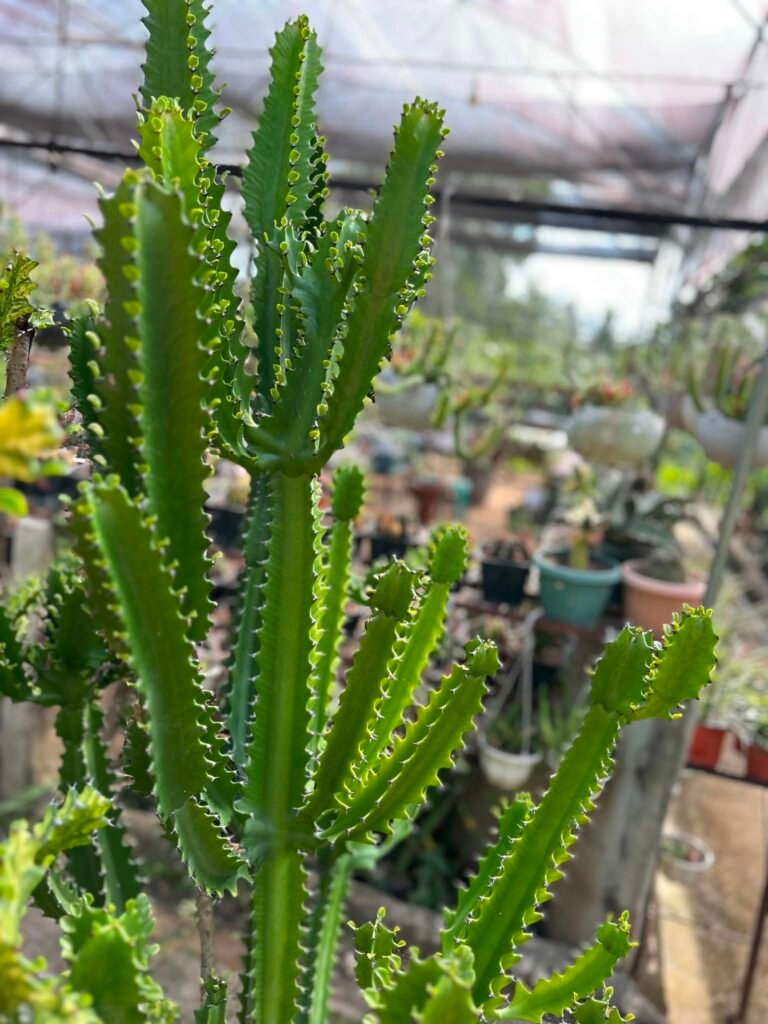
📷 Figure 1. Euphorbia lactea Haw.
Plant Photography: Green Desert Botanical Library
Picture Description
A vigorous specimen of Euphorbia lactea, commonly known as the Dragon Bone Euphorbia, displays its distinctive upright candelabra-like growth. The broad, four-angled stems are bright emerald green with gently undulating winged margins lined by paired spines and tiny developing leaves. Fresh new shoots emerge from the upper branches, illustrating the plant’s active growth and symmetrical branching habit. Photographed at Green Desert Agritourism Park, this specimen represents the classic green form from which many spectacular crested and variegated cultivars have been developed.
Plant Description
Euphorbia lactea is one of the most recognizable succulent spurges, admired for its dramatic candelabra-shaped architecture and richly textured winged stems. Native to tropical regions of India and Sri Lanka, it naturally develops upright, branching stems with four distinct angles and scalloped margins lined with paired spines. Unlike true cacti, it belongs to the spurge family (Euphorbiaceae) and produces a characteristic white milky latex when injured.
The species serves as the parent plant for many famous ornamental cultivars, including the Green Crested Dragon Bone Euphorbia, White Ghost, and numerous variegated forms. Its strong vertical growth, drought tolerance, and sculptural appearance have made it one of the world’s most popular ornamental succulent shrubs for gardens and botanical collections.
Basic Information
Scientific Name: Euphorbia lactea Haw.
Author Citation: Haw.
Family: Euphorbiaceae
Genus: Euphorbia
Plant Type: Succulent shrub
Origin: India and Sri Lanka
Plant Overview
The Dragon Bone Euphorbia grows as a multi-branched succulent shrub with thick winged stems that branch repeatedly to form an impressive candelabra-shaped canopy. Each stem stores water within its fleshy tissues, allowing the plant to survive prolonged drought while continuing to grow under hot tropical conditions.
Tiny leaves appear only on actively growing stem tips before naturally dropping, leaving the green stems to perform nearly all photosynthesis. Because of its vigorous growth and stability, Euphorbia lactea is widely cultivated both as an ornamental specimen and as the foundation from which numerous horticultural cultivars and crested forms have been selected.
Botanical Description
Growth Habit
An upright, branching succulent shrub with a candelabra-like form.
Mature Size
- Height: 2–5 meters
- Spread: 1–3 meters
Smaller when grown in containers.
Stem
- Four-angled succulent stems
- Bright green
- Thick water-storing tissue
- Wavy winged margins
- White milky latex when cut
Leaves
Tiny, narrow leaves appear briefly on new growth before naturally falling.
Spines
- Short paired spines
- Gray to brown
- Located along the wing margins
Roots
Fibrous root system adapted to dry, well-drained soils.
Flowers
Produces tiny yellow-green cyathia near actively growing stems.
Fruits
Small three-lobed capsules.
Seeds
Small, rounded seeds are released when mature.
Native Habitat
Geographic Distribution
Native to:
- India
- Sri Lanka
Natural Ecosystem
- Dry tropical forests
- Rocky hillsides
- Open scrublands
- Semi-arid landscapes
Climate
Warm tropical to subtropical climates with seasonal rainfall.
Soil Type
Well-drained sandy, rocky, or gravelly soils.
Growing Conditions
Light
Thrives in full sun to bright filtered light.
Watering
Allow the soil to dry completely before watering again.
Soil
Fast-draining cactus or succulent mix with abundant mineral material.
Temperature
Ideal:
20–35°C
Protect from temperatures below 10°C.
Humidity
Prefers low humidity and excellent air circulation.
Fertilization
Feed lightly once or twice during the growing season using a balanced cactus fertilizer.
Potting
Grow in sturdy containers with excellent drainage.
Propagation
Usually propagated from stem cuttings.
Allow cuttings to callus completely before planting.
⚠ Wear gloves because the white milky latex may irritate the skin.
Growth Rate
Moderate.
Dormancy
Growth slows during cool weather and extended dry periods.
Toxicity
⚠ Caution
Like all members of the genus Euphorbia, this plant produces a white milky latex that:
- Irritates the skin.
- May cause severe eye injury.
- Is toxic if ingested.
Keep away from children and pets.
Pests and Diseases
Common problems include:
- Mealybugs
- Scale insects
- Spider mites
- Root rot from excessive watering
- Fungal stem diseases in poorly drained soils
Interesting Facts
- The parent species of many famous ornamental cultivars, including White Ghost, variegated forms, and crested forms.
- The winged stems store water, allowing survival during long droughts.
- Tiny leaves appear only on actively growing shoots.
- Commonly mistaken for a cactus but belongs to the spurge family.
- One of the most widely cultivated ornamental Euphorbia species worldwide.
- Frequently used in botanical gardens as an example of convergent evolution between euphorbias and cacti.
Landscape and Collection Value
Recommended for:
- Botanical gardens
- Xeriscape landscapes
- Collector of succulent collections
- Architectural landscape design
- Educational displays
Its upright candelabra form makes it an outstanding focal point in both gardens and container displays.
Conservation Status
Euphorbia lactea is widely cultivated throughout tropical and subtropical regions. Although naturally occurring in parts of India and Sri Lanka, cultivated plants contribute significantly to the preservation and appreciation of this remarkable species.
Life’s Whisper
“Stand tall with quiet confidence. Like the Dragon Bone Euphorbia, true strength is built one steady branch at a time, reaching upward while remaining firmly rooted.”
Green Desert Botanical Library Notes
This specimen forms part of the living collection of Green Desert Agritourism Park. Its vigorous upright growth and healthy branching habit represent the classic green form of Euphorbia lactea, the foundation from which many extraordinary crested and variegated cultivars have arisen. It serves as an important educational specimen illustrating the natural beauty and diversity of the genus Euphorbia.
Navigation
⬅ Previous Plant: Euphorbia tirucalli (Pencil Tree)
🏠 Home: Botanical Library – Euphorbia Collection
➡ Next Plant: Euphorbia lactea ‘Variegata’
References
For the complete list of botanical references, scientific literature, and online resources used in preparing the Green Desert Botanical Library, please visit the References page available from the Main Menu.